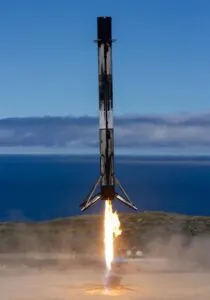
Falcon 9 Flight Computer is a flight computer system manufactured by SpaceX. It features triple modular redundancy redundancy.
The Falcon 9 flight computer is the fault-tolerant “brain” that guides SpaceX’s Falcon 9 rocket from liftoff to orbit — and, for the first stage, all the way back to a precision landing. What makes it unusual is that it relies on cheap, ordinary computer chips kept reliable through clever redundancy rather than on expensive specialized hardware.
Quick facts
- Job: guides ascent, controls the engines, separates the stages, and flies the first stage back for landing.
- Architecture: a triple-redundant (“triplex”) computer using an “Actor-Judge” voting scheme. Redundant means more than one copy does the same job, so a failure of one is not fatal.
- Main processors: three dual-core x86 processors (the same general chip family as in a typical PC). Each core runs its own copy of Linux.
- Software: written in C/C++ (commonly cited as C++).
- Engine and grid-fin control: lower-level controllers use PowerPC-architecture microcontrollers — small, single-purpose computers on a chip.
- Reported scale: on the order of about 30 processors across the vehicle, roughly three flight computers per engine (figures widely cited in technical write-ups, not an official SpaceX spec).
- Radiation approach: radiation-tolerant, not radiation-hardened — it detects and recovers from errors rather than being built to prevent them.
How it works
The flight computer is built from three independent “flight strings.” A flight string is a dual-core computer running Linux. Each string does every calculation twice — once on each of its two cores — and then compares the two answers. If the cores agree, the string is healthy and sends its command onward. If they disagree, the string declares itself faulty and stays silent.
The three healthy strings are then checked against each other. This is the “Actor-Judge,” or voting, step: the lower-level PowerPC microcontrollers that actually drive the Merlin engines and the grid fins (the small steering flaps used during descent) act on a command only when the strings agree. If one string has gone bad, the system trusts the strings that have stayed consistently correct.
Think of it like three accountants each working a sum twice, then comparing notes before anyone signs the check. A mistake by one person is caught immediately and outvoted by the others. Because the strings are fully independent, the rocket can keep flying and finish its mission even when it is down to a single working string.
Why it matters
Traditional rockets used costly, slow-to-evolve radiation-hardened processors — chips physically built to resist the charged particles in space. SpaceX took the opposite path: fast, inexpensive consumer-grade chips made dependable through triple redundancy and self-checking. When a cosmic ray flips a single bit and corrupts one processor (a “bit flip”), the mismatch is caught at once. The bad processor reboots, then “re-syncs” — it copies the correct, current state back from the still-healthy strings — and flight continues without interruption.
This “redundancy over hardening” philosophy cut cost and let engineers iterate software quickly with standard, familiar tools, while still delivering the reliability needed for crewed and high-value missions. It has become influential across the new commercial space industry. One trade-off worth noting: Falcon’s relatively short, largely sub-orbital flight means its total radiation exposure is low, which makes the tolerate-and-recover model practical. Longer deep-space missions face a harsher radiation environment.
Where it’s used
- Falcon 9 first stage: runs ascent guidance, engine throttling and shutdown, stage separation, and the boostback, entry, and landing burns for booster recovery.
- Falcon 9 second (upper) stage: carries its own flight computers of the same fault-tolerant design to manage orbital insertion.
- Merlin engines: each engine has its own PowerPC controllers, enabling per-engine monitoring and engine-out tolerance — the ability to lose an engine and still complete the mission.
- Crew and Cargo Dragon: use the same radiation-tolerant, triple-redundant approach for missions to the International Space Station.
- Falcon Heavy: inherits the Falcon 9 avionics and flight-computer architecture across its three cores.
Triple-redundant x86 Linux processors with majority voting; convex optimization for landing guidance
| CATEGORY | Flight Computer |
| TYPE | Triple-Redundant Linux SBC |
| MANUFACTURER | SpaceX |
| MASS | 8 kg |
| POWER CONSUMPTION | 60 W |
| REDUNDANCY | Triple modular redundancy |
| RADIATION HARDENED | No — COTS with software fault tolerance |
| ACCURACY | N/A |
| FIRST USE | June 4, 2010 |
| STATUS | Active |
| OS | Linux |
| ARCHITECTURE | x86 |
| ENGINES_MANAGED | 9 (first stage) |
| LANDING_CAPABLE | Yes |