Thermal Protection

Heat Shields & TPS

The ablative shields and ceramic tiles that survive the inferno of atmospheric re-entry.
19 heat shields8 material types10 in service

19 heat shields
2,200°C
ACTIVE
Ablative
SAFRAN / AIRBUS DEFENCE
3D Quartz Phenolic
2,200°CAblativeActive
Huygens probe, European reentry vehicles, Ballistic reentry vehicles
816°C
Flexible Blanket
LOCKHEED MARTIN
AFRSI (Advanced Flexible Reusable Surface Insulation)
816°CReusableRetired (Shuttle)
Space Shuttle (upper surfaces, payload bay doors)
2,800°C
ACTIVE
Ablative
TEXTRON SYSTEMS
AVCOAT
2,800°CAblativeActive
Apollo Command Module, Orion MPCV
1,100°C
ACTIVE
Ablative (Spray-On)
SPACEX
Dragon 2 SPAM-T
1,100°CAblativeReusableActive
Dragon 2 (Crew Dragon), Dragon 2 (Cargo Dragon)
1,260°C
Ceramic Tile
LOCKHEED MARTIN
FRCI (Fibrous Refractory Composite Insulation)
1,260°CReusableRetired (Shuttle)
Space Shuttle (high-stress areas, forward fuselage)
How Does Atmospheric Re-entry Work? Heat, Plasma, and Physics
ACTIVE
Concept
How Does Atmospheric Re-entry Work? Heat, Plasma, and Physics
15,000°CActive
1,260°C
Ceramic Tile
LOCKHEED MARTIN
HRSI (High-Temperature Reusable Surface Insulation)
1,260°CReusableRetired (Shuttle)
Space Shuttle (lower fuselage, wing undersides)
1,260°C
Ceramic Tile
LOCKHEED MISSILES & SPACE COMPANY
LI-2200
1,260°CReusableRetired (Shuttle)
Space Shuttle (high-load areas)
1,260°C
Ceramic Tile
LOCKHEED MISSILES & SPACE COMPANY
LI-900 Silica Tiles
1,260°CReusableRetired (Shuttle)
Space Shuttle (lower surface)
649°C
Ceramic Tile
LOCKHEED MARTIN
LRSI (Low-Temperature Reusable Surface Insulation)
649°CReusableRetired (Shuttle)
Space Shuttle (upper fuselage, orbital maneuvering pods)
1,200°C
Multi-Layer Shield
3M / NASA JPL
Nextel/SiC (Stardust WSIM)
1,200°CReusableHeritage
Stardust, ISS (Whipple shield concept adaptation)
2,900°C
ACTIVE
Ablative
FIBER MATERIALS INC. / NASA AMES
PICA (Phenolic Impregnated Carbon Ablator)
2,900°CAblativeActive
Stardust, Mars Science Laboratory, OSIRIS-REx
1,850°C
ACTIVE
Ablative
SPACEX
PICA-X
1,850°CAblativeReusableActive
Dragon 1, Dragon 2 (Crew Dragon), Dragon XL
1,650°C
Refractory Composite
LTV AEROSPACE / LOCKHEED MARTIN
Reinforced Carbon-Carbon (RCC)
1,650°CReusableRetired (Shuttle)
Space Shuttle (nose cap, wing leading edges), X-37B
1,750°C
ACTIVE
Ablative
NASA AMES RESEARCH CENTER
SIRCA
1,750°CAblativeActive
Mars Pathfinder, Stardust, Various probe backshells
1,900°C
ACTIVE
Ablative
LOCKHEED MARTIN
SLA-561V
1,900°CAblativeActive
Viking 1/2, Mars Pathfinder, MER Spirit/Opportunity
1,400°C
ACTIVE
Ablative (Spray-On)
LOCKHEED MARTIN
SPAM (SLA Spray-On)
1,400°CAblativeActive
Mars Pathfinder (backshell), MER Spirit/Opportunity (backshell), Mars Phoenix (backshell)
1,760°C
ACTIVE
Refractory Composite
NASA AMES RESEARCH CENTER
TUFROC
1,760°CReusableActive
X-37B, Next-gen reusable vehicles (development)
2,200°C
Refractory Ceramic
VARIOUS (NASA, DARPA RESEARCH PROGRAMS)
UHTC Composites
2,200°CReusableDevelopment
SHARP-B2 test vehicle, Hypersonic glide vehicles (development), Next-gen reentry vehicles

Explore every thermal protection system used in spaceflight — from the ablative PICA-X on Dragon to the ceramic tiles of the Space Shuttle. Space Launch Live catalogs material types, temperature limits, composition data, and the vehicles protected by each heat shield technology.

The Physics of Re-entry

Explore ablative shields like PICA-X and AVCOAT, ceramic tiles from the Space Shuttle, and Starship’s next-generation hex tiles. Understand the physics of re-entry heating and how each material protects the spacecraft behind it.

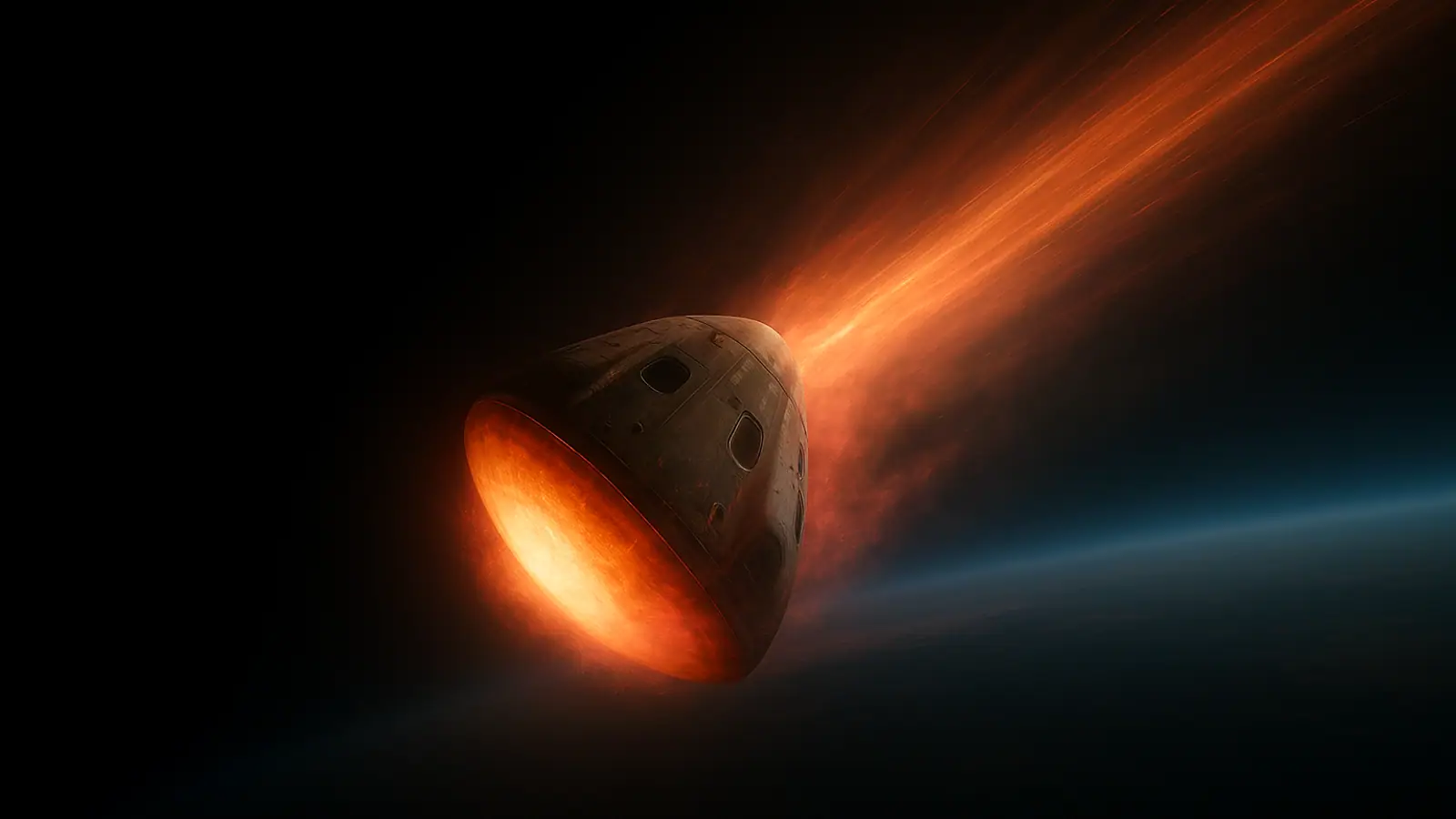
A capsule returning from low Earth orbit hits the atmosphere at roughly 7.8 km/s — about 28,000 km/h. Almost all of the heat comes from shock-compressing the air ahead of the vehicle, not friction: the gas in that shock layer can exceed 1,650 °C (3,000 °F). Spacecraft coming back from the Moon arrive even faster — Apollo and Orion re-enter near 11 km/s, and NASA’s Stardust sample capsule set the human-made record at 12.9 km/s in 2006.

Thermal protection comes in two families. Ablative shields char and slowly erode, carrying heat away as the surface burns off: NASA’s PICA (Phenolic Impregnated Carbon Ablator) flew on Stardust, SpaceX’s denser PICA-X variant protects Crew Dragon, and AVCOAT lined the Apollo command module and now coats Orion. Reusable systems instead re-radiate heat — the Space Shuttle carried roughly 24,000 individually-shaped silica tiles plus reinforced carbon-carbon on its nose cap and wing leading edges, while SpaceX’s Starship uses around 18,000 hexagonal ceramic tiles engineered for rapid reflight without refurbishment.