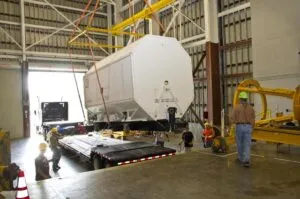
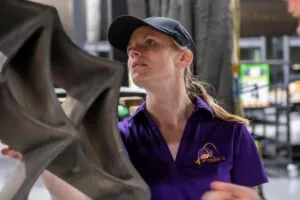
PICA (Phenolic Impregnated Carbon Ablator) is a ablative thermal protection system by Fiber Materials Inc. / NASA Ames. Rated to 2,900°C. Status: Active.
When a spacecraft returning from deep space slams into the atmosphere, the air in front of it can heat to thousands of degrees. PICA is a special lightweight material that protects the vehicle by being deliberately burned away, carrying that heat off with it.
Quick facts
- Full name: Phenolic Impregnated Carbon Ablator
- Developer: NASA’s Ames Research Center (research begun in the 1980s; the material matured in the mid-1990s for the Stardust comet-sample mission)
- Density: very low, roughly 0.27 g/cm³ (commonly cited as 0.26–0.28 g/cm³), which is why it is so light
- Insulation: very poor at conducting heat, around 0.10–0.11 W/(m·K) — and being a poor heat conductor is exactly what makes it a great heat shield
- Heat handled: works across heating rates from about 250 up to roughly 1000 watts per square centimeter (and the Stardust shield was sized for an even higher peak)
- Single-use: the surface is intentionally consumed and cannot be reused without refurbishment
What it is and how it works
PICA is an ablative heat shield, meaning it protects a spacecraft by being eaten away rather than by simply staying put and insulating. The core is a rigid, extremely porous block of carbon fiber called FiberForm — carbon strands carbonized from rayon and wood-pulp cellulose — that is then soaked with a phenolic resin, a heat-resistant plastic. Because the block is mostly empty void space, the finished material is remarkably light.
During atmospheric entry, the outer surface heats to thousands of degrees. The phenolic resin pyrolyzes (chemically decomposes from the heat) and chars, breaking down at temperatures up to about 1200 °C, and the surface slowly burns and erodes away. Two things carry heat off the vehicle. First, energy is absorbed in breaking the resin down. Second, that breakdown releases gases — hydrogen, methane, water vapor, carbon monoxide — that flow outward through the char and blow into the oncoming hot air, pushing incoming heat back. The blackened char layer left behind re-radiates heat away. Think of it like a candle held into a flame: the wax sacrifices itself, and the rising vapor keeps the heat at bay.
Because the leftover material conducts heat so poorly, the back face stays cool enough to protect the spacecraft and its contents even while the front face is being burned off. Engineers simply size the shield thick enough that plenty remains after ablation.
Why it matters
PICA solved a hard problem: surviving extreme entry heat with a shield light enough to actually fly. Capsules returning from other worlds hit the atmosphere far faster than vehicles coming back from low Earth orbit, producing heating that overwhelms ordinary materials — yet every kilogram of heat shield is a kilogram taken away from payload and fuel. PICA’s mix of very low weight and high heat tolerance made demanding missions possible. It remains a baseline thermal-protection choice for NASA’s Discovery and New Frontiers planetary missions, and keeping a reliable supply of qualified PICA for future missions has itself been the focus of dedicated NASA work.
It is also a rare success story of NASA technology moving into private industry. SpaceX worked with PICA’s original Ames inventors to create a licensed, manufacturing-optimized variant called PICA-X — reportedly cheaper and faster to produce — giving the company an in-house heat shield for its crew and cargo flights to and from the International Space Station.
Notable examples
- Stardust Sample Return Capsule: the first flight use of PICA, built as a single solid forebody shield; it survived the fastest atmospheric reentry of any human-made spacecraft (about 12.9 km/s) when it delivered comet Wild 2 dust in 2006.
- SpaceX Dragon (Dragon 1 and Crew Dragon): uses the tiled PICA-X variant, first flown on COTS Demo Flight 1 in 2010, protecting both cargo and crew during reentry.
- Mars Science Laboratory / Curiosity rover (2012): rigid PICA tiles on its large aeroshell — the first tiled ablative heat shield ever flown — survived entry into the Martian atmosphere.
- Mars 2020 / Perseverance rover (2021): a PICA aeroshell endured roughly 1300 °C (about 2370 °F) during Martian entry, instrumented with the MEDLI2 sensor suite.
- OSIRIS-REx Sample Return Capsule (2023): a PICA shield protected the asteroid Bennu samples through a high-speed Earth reentry with surrounding air heated to roughly 2900 °C (about 5300 °F).
Trade-offs
PICA’s strengths come with limits. The same extreme porosity that makes it light and insulating also makes it relatively brittle and prone to surface erosion, so it is often given a densified or coated surface. It is fielded either as one solid piece (Stardust) or as gap-filled tiles for larger aeroshells (Dragon, Curiosity). And because the front face is meant to be consumed, the shield is single-use — the fundamental trade-off against reusable, heat-radiating shields. NASA has pursued surface densification and flexible PICA variants to toughen the material and let it wrap around curved or deployable structures.
Phenolic resin infused into carbon fiber preform (FiberForm)