AVCOAT is a ablative thermal protection system by Textron Systems. Rated to 2,800°C. Status: Active.
AVCOAT is the heat shield that has brought astronauts home from the Moon – a material designed not to survive reentry unscathed, but to burn away on purpose so the people behind it stay safe.
Quick facts
- Full name: AVCOAT 5026-39 (and variants such as 5026-39HCG), developed by the Avco Corporation for NASA’s Apollo program in the 1960s. Avco was acquired by Textron in 1984, and Textron now licenses the material.
- Type: an ablative thermal protection system – a heat shield meant to be consumed during reentry rather than to simply insulate.
- What it’s made of: silica (glass) fibers in an epoxy-novolac resin, mixed with tiny hollow spheres called microballoons, packed into a fiberglass-phenolic honeycomb.
- Density: roughly 32 lb/ft³ (about 0.51 g/cm³) before it ablates.
- Heat tolerance: surface temperatures up to about 5,000°F (2,760°C) – roughly half the temperature of the Sun’s surface.
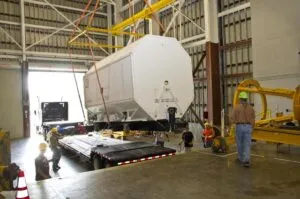
- Orion shield: a dish about 16.5 ft (~5 m) across, with an ablative layer roughly one to three inches thick.
What it is and how it works
A spacecraft returning to Earth slams into the atmosphere at enormous speed. The Orion crew capsule, for example, enters at about 25,000 mph and is slowed to roughly 300 mph within minutes before parachutes take over. Friction with the air heats the leading surface to thousands of degrees. The challenge is keeping that heat away from the crew.
AVCOAT does this by sacrificing itself. As the capsule plunges in, the resin chars, melts, and vaporizes layer by layer. The hot gases that boil off flow away from the surface, physically carrying thermal energy with them. Engineers call this the “blowing” effect: the outgassing pushes the searing-hot boundary layer of air away from the spacecraft’s skin. Think of it like sweat cooling your body – as the moisture evaporates, it carries heat away. AVCOAT works the same way, except it is “sweating” away its own substance.
The fiberglass honeycomb (or the shape of the molded blocks) holds the brittle char in place so the material erodes evenly. By the time reentry ends, much of the shield has burned away – yet on Orion, the back of the shield stays near 200°F and the crew cabin holds in the mid-70s°F. At high-stress points like bolt connections, Orion uses a complementary woven material called 3DMAT (quartz threads in resin) for extra strength.
Why it matters
AVCOAT is one of the most flight-proven crewed-reentry materials in history. Returning from the Moon is far more punishing than returning from the International Space Station, so a shield proven to survive about 5,000°F is essential for deep-space missions. Decades of flight heritage – backed by more than 1,000 arc-jet tests at NASA’s Ames Research Center across roughly 15 years of Orion development – made it a trusted, low-risk choice.
Its behavior is still an active engineering story. After the uncrewed Artemis I flight, NASA found that gases couldn’t escape fast enough through parts of the AVCOAT that weren’t permeable (porous) enough. During Orion’s gentle “skip” reentry, the slower, cooler heating let pressure build up under the char, which caused cracking and char loss. NASA traced the cause and, rather than swap out the already-built Artemis II shield, flew it on a steeper, more direct reentry path that cut the punishing plasma exposure roughly in half – and it worked. For Artemis III and later flights, NASA is changing how the AVCOAT is loaded into its molds to make a more uniformly permeable shield. It’s a reminder that even trusted materials must be re-qualified for new flight paths.
Where it’s used and notable examples
- Apollo command modules: AVCOAT protected every crewed Apollo mission (Apollo 7-17), the Skylab crew ferries, and the Apollo-Soyuz Test Project. On Apollo, a single honeycomb of about 330,000 cells was each filled by hand (“gunned”) with AVCOAT paste – a process that took roughly six months.
- Early Apollo test flights: AS-201, AS-202, Apollo 4, and Apollo 6 qualified the shield uncrewed.
- Orion EFT-1 (2014): the first Orion flight test used a gunned/honeycomb shield in the Apollo style.
- Artemis I (2022): the uncrewed lunar flight used new molded AVCOAT blocks – just under 200 of them – fitted together puzzle-like, far faster than gunning hundreds of thousands of cells. The blocks are produced at NASA’s Michoud Assembly Facility in New Orleans by Lockheed Martin under Textron license.
- Artemis II (2026): the first crewed Artemis Moon flight. Its four astronauts looped around the Moon and splashed down safely on April 11, 2026, behind a block-based AVCOAT shield of the same design as Artemis I. Inspections showed far less char loss than on Artemis I, validating the steeper reentry plan.
Epoxy novolac resin with silica and phenolic microballoons in fiberglass honeycomb