PICA-X is a ablative thermal protection system by SpaceX. Rated to 1,850°C. Status: Active.
When a spacecraft falls back to Earth, the air in front of it heats to thousands of degrees. PICA-X is the heat shield SpaceX uses to absorb that fury and bring its Dragon capsules home in one piece.
Quick facts
- Full name: PICA-X, SpaceX’s variant of PICA (Phenolic-Impregnated Carbon Ablator), a material originally invented at NASA’s Ames Research Center.
- Type: An ablative thermal protection system (TPS) — the primary, forward-facing heat shield on the Dragon spacecraft.
- Made of: A carbon-fiber backbone (called FIBERFORM) soaked with a hardened phenolic resin, giving a ceramic-carbon structure.
- Very light: Base PICA is roughly 0.24–0.28 g/cm³, about one-fifth the weight of comparable heat shields.
- Heat tolerance: Tested to about 1,850 °C (around 3,360 °F); NASA cites the material withstanding up to roughly 5,000 °F (about 2,760 °C).
- First flight: Dragon COTS Demo Flight 1, December 8, 2010 — the first private spacecraft recovered from orbit.
What it is and how it works
PICA-X is an ablative heat shield, which means it is built to be sacrificed. Instead of trying to bounce heat away or soak it up, the material deliberately burns and erodes in a controlled way, carrying the heat off with it.
Here is what happens during reentry. A returning capsule slams into the atmosphere at hypersonic speed — many times the speed of sound. The air piling up in front of it gets violently compressed and superheated, forming a glowing layer called the shock layer. As that heat hits PICA-X, the phenolic resin inside pyrolyzes (chemically breaks down) and the surface chars and flakes away. Turning solid material into gas absorbs an enormous amount of energy, and the outgassing pushes the hottest air back away from the surface — an effect engineers call blowing.
Think of it like a candle held under a draft. The wax does the work of being consumed so the flame stays at a distance. Meanwhile, the carbon-fiber backbone holds the charred outer layer together and acts as a superb insulator. The result is that the outer face can glow at thousands of degrees while the inner side, facing the crew and cargo, stays safe. Because the carbon matrix is full of tiny empty pores, the whole shield does this at a fraction of the weight of older designs.
Why it matters
PICA-X solved two hard problems at once: surviving reentry and being affordable. The parent material, NASA’s PICA, was already proven on demanding missions, but it was costly to make. With NASA’s technical support, SpaceX re-engineered it into PICA-X, reported to be about ten times cheaper to manufacture than the original.
That cost breakthrough is what made a reusable cargo-and-crew capsule practical. The heat shield is the main part that must be inspected, and possibly refurbished, between flights — after each return, engineers check how much material remains to decide whether that shield can fly again. PICA-X is a flagship example of NASA technology being transferred to a commercial company, and it protected the Dragon capsule on the 2010 flight that made SpaceX the first private firm to return a spacecraft from orbit.
Notable examples
- NASA Stardust Sample Return Capsule: Used the original PICA as its forward heat shield, surviving a reentry of about 28,900 mph (roughly 12.9 km/s) on January 15, 2006 — the fastest reentry of any human-made object at the time. Its shield was a single piece about 5 cm thick on a roughly 1-meter capsule.
- SpaceX Dragon 1 (cargo Dragon): The first vehicle to fly PICA-X, on the December 2010 demo flight, and on later space-station cargo returns. Because Dragon’s shield is much larger (about 3.6–4 meters across), it is built from many smaller PICA-X tiles assembled into one shield.
- SpaceX Crew Dragon (Dragon 2): Uses an evolved version of PICA-X to protect astronauts during reentry, inspected between missions for reuse.
- PICA-X v3: An upgraded version rated to sustain higher heat flux (on the order of 1 kilowatt per square centimeter) and tolerate roughly double the kinetic energy of a Mach 25 reentry, aimed at greater reusability.
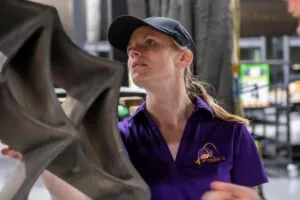
Phenolic resin impregnated carbon fiber preform