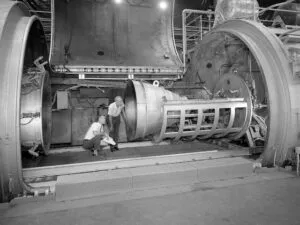
Monel 400
Monel 400 is a nickel-copper alloy used in aerospace applications. Melting point: 1,300 °C. Tensile strength: 550 MPa.
Monel 400 is a nickel-copper metal with one rare superpower: it shrugs off fluorine, one of the most savagely corrosive substances a rocket engineer ever handles. That single trait helped make fluorine-powered propulsion physically possible.
Quick facts
- Names and code: Monel 400, also called Alloy 400, with the official designation UNS N04400 (a standardized code that identifies the exact alloy).
- What’s in it: at least 63% nickel (typically around 63-67%), 28-34% copper, up to 2.5% iron, up to 2.0% manganese, plus small amounts of carbon and silicon.
- Structure: a single-phase nickel-copper solid solution, meaning the two main metals are blended into one uniform material rather than separate layers.
- Temperature range: stays tough from cryogenic (“cryogenic” means extremely cold) temperatures as low as the -253°C / 20 K of liquid hydrogen, up to roughly 538°C (1000°F) in continuous service.
- Born: developed in 1905 (patented 1906) at the International Nickel Company, or Inco.
- Cost: among the more expensive common engineering alloys, mostly because of its high nickel content.
What it is and how it works
Monel 400 was created in 1905 by Robert Crooks Stanley at Inco and named after the company’s president, Ambrose Monell. It is a substitutional solid-solution alloy, which means copper atoms slip in among the nickel atoms and take their place within the same crystal framework. That framework is a face-centered-cubic (FCC) structure, a particular orderly arrangement of atoms. The FCC structure is the key to one of Monel’s best tricks: it stays ductile (bendable rather than brittle) across an enormous range of temperatures, including the deep cold where many steels would shatter like glass.
Its resistance to fluorine works almost like a self-applied shield. When Monel meets fluorine, its surface forms a thin, tightly bound metal-fluoride film, a passivation layer that seals the metal beneath. Think of it as a scab that forms instantly and then stops the wound from getting worse: the reaction self-limits instead of running out of control. This same nickel-copper toughness also makes Monel a reliable choice for the sealing surfaces and inner parts of valves carrying liquid oxygen, liquid hydrogen, and liquid fluorine.
Why it matters
Fluorine is a tempting rocket oxidizer (an oxidizer is the chemical that lets fuel burn). Fluorine-based propellant combinations can offer up to roughly a 40% performance boost over conventional propellants. The catch is that fluorine is extraordinarily reactive and toxic, so the central engineering challenge becomes finding any material that can hold it. Monel 400 is one of the materials that makes building, fueling, and testing fluorine and FLOX (a fluorine-oxygen mixture) systems possible at all. NASA explicitly recommends nickel-base alloys such as Monel 400 for the high-pressure parts of fluorine delivery systems.
Beyond exotic oxidizers, Monel’s ability to stay ductile at liquid-hydrogen temperatures makes it valuable for cryogenic valves and plumbing on conventional liquid-oxygen, liquid-hydrogen, and liquid-methane launch vehicles, and in engine test facilities. Its heat and corrosion resistance also earned it a role in early hypersonic rocket-plane structures.
Where it’s used
- Liquid fluorine and FLOX propulsion: NASA’s materials research at Lewis Research Center (begun in 1957) identified Monel and nickel-base alloys for fluorine and FLOX service, and NASA’s SP-3037 guidance favors Monel 400 for the high-pressure side of fluorine hardware.
- North American X-15 rocket plane: Monel was used in this hypersonic aircraft’s frames and propellant-system parts to handle the heat of high-speed flight, alongside the Inconel-X that formed the primary outer skin. (Monel was a supporting material here, not the X-15’s main skin.)
- Cryogenic valves: Monel 400 internals are used in valves for propellant systems and rocket-engine test facilities, where parts must seal tightly at liquid-oxygen and liquid-hydrogen temperatures.
- Fluorine and hydrogen-fluoride handling: remote-controlled, Monel- or nickel-lined systems are the standard for safely containing and routing these aggressive propellant chemicals.
A few trade-offs are worth knowing. Monel’s high nickel content makes it costly, so engineers use it selectively where its fluorine and cold-temperature resistance is truly needed. Its strength falls off above roughly 500-550°C, so it is not used for the searing-hot combustion chamber; that job goes to superalloys like Inconel. A heat-treated version, Alloy 400AR, exists for aerospace uses such as honeycomb cores. Finally, fluorine compatibility depends on clean, properly passivated systems: even compatible metals can ignite in fluorine if contaminated or mishandled, which is why fluorine systems are operated remotely under strict containment.
Ni 63%, Cu 28-34%, Fe 2.5% max, Mn 2% max
| DENSITY | 9 kg/m³ |
| TENSILE STRENGTH | 550 MPa |
| YIELD STRENGTH | 240 MPa |
| STRENGTH-TO-WEIGHT | 62500 kN·m/kg |
| MELTING POINT | 1,300 °C |
| MAX SERVICE TEMPERATURE | 480 °C |
| THERMAL CONDUCTIVITY | 21.8 W/m·K |
| THERMAL EXPANSION | 13.9 µm/m·K |
| CATEGORY | Nickel-Copper Alloy |
| DESIGNATIONS | UNS N04400, AMS 4544, QQ-N-281 |
| MANUFACTURER | Special Metals Corporation |
| DENSITY | 9 kg/m³ |
| TENSILE STRENGTH | 550 MPa |
| YIELD STRENGTH | 240 MPa |
| MELTING POINT | 1,300 °C |
| MAX SERVICE TEMP | 480 °C |
| THERMAL CONDUCTIVITY | 21.8 W/m·K |
| THERMAL EXPANSION | 13.9 µm/m·K |
| CORROSION RESISTANCE | Excellent |
| WELDABILITY | Good |
| MACHINABILITY | Fair |
| COST RATING | High |