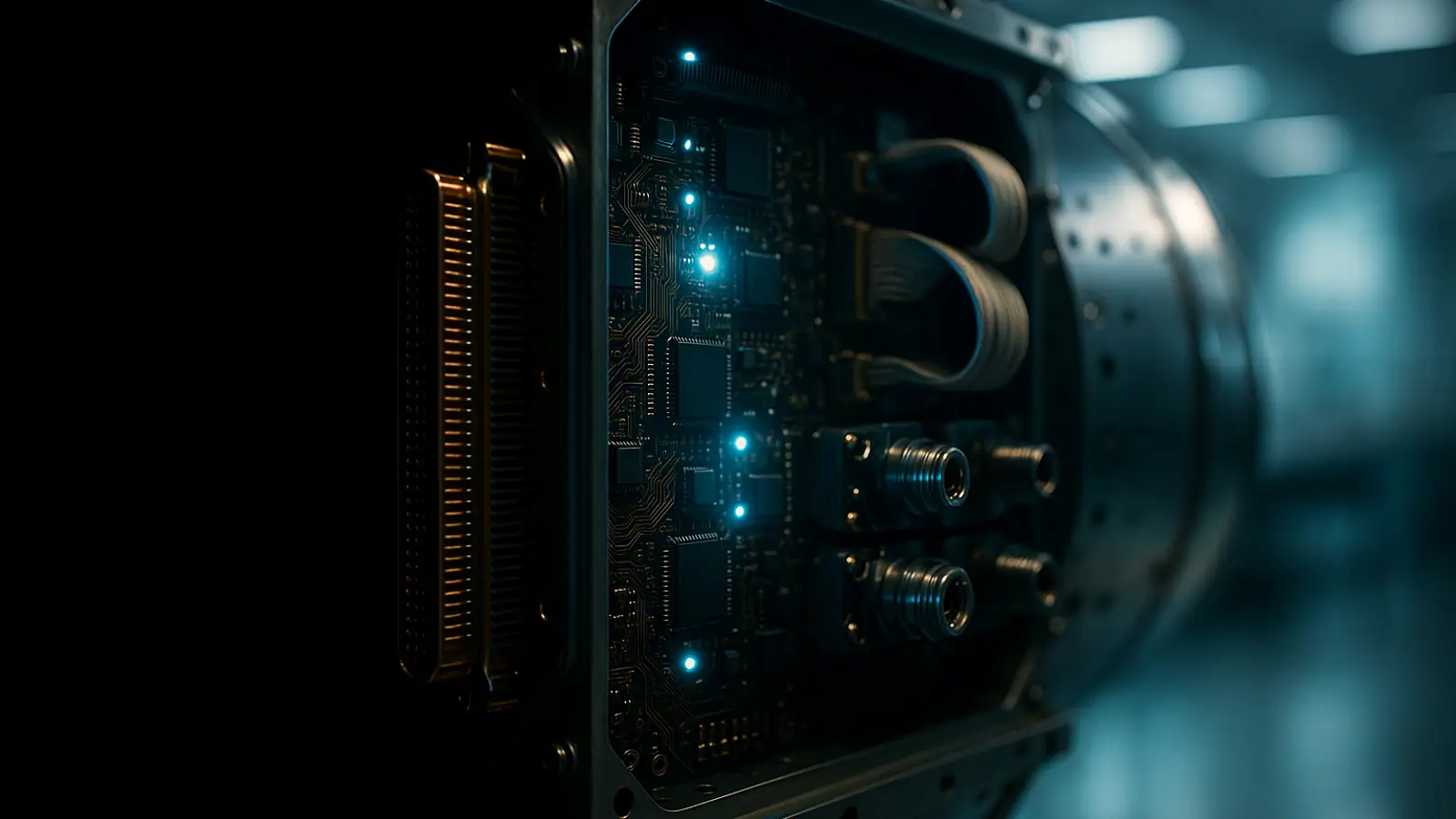
AVIONICS & GUIDANCE

Flight computers, GNC systems, IMUs, and the electronics that guide rockets to orbit.

From inertial measurement units to autonomous flight-safety systems — explore the avionics that make precision spaceflight possible, and the guidance algorithms, radiation hardening, and redundant architectures behind them.

Avionics handle guidance, navigation, and control (GNC) — knowing where the rocket is, where it should be, and how to steer there. An inertial measurement unit of accelerometers and gyroscopes senses every change in motion thousands of times a second; modern vehicles fuse it with GPS so position drift stays small all the way to orbit. The flight computer turns that picture into commands — gimballing engines and firing thrusters — closing the loop continuously from liftoff to spacecraft separation.

Space is unforgiving of electronics, so the designs build in margin. Critical computers are radiation-hardened (chips like the RAD750 keep running through cosmic rays and solar particles that would crash ordinary processors), and they are often redundant and voting — Falcon 9 flies triple-redundant strings of processors that cross-check each other so any single faulty result is outvoted. A modern addition is the Autonomous Flight Safety System: an onboard computer that can terminate a rocket straying off course without a human range-safety officer, which is part of how SpaceX flies and lands so often at lower cost.

AVIONICS SYSTEMS

Guidance, navigation & control systems powering spaceflight — flight computers, IMUs, star trackers, and more.

20 systems
● Active
VARIOUS (CONTRACTOR-DEPENDENT)
Autonomous Flight Safety System (AFSS)
Range SafetyDual fault-tolerant
● Active
BAE SYSTEMS
BAE RAD750 Flight Computer
Flight ComputerMission-dependent (typically dual)
● Active
SPACEX
Dragon Flight Computer
Flight ComputerTriple modular redundancy (vote-based)
● Active
DRAPER LABORATORY
Draper CAMS (Crew Autonomy)
GN&C SystemDual with manual backupRAD HARD
● Active
SPACEX
Falcon 9 Flight Computer
Flight ComputerTriple modular redundancy
● Active
VARIOUS (ENSIGN-BICKFORD, SPACEX, ULA)
Flight Termination System (AFTS)
Range SafetyDual-redundant (independent chains)
● Active
GENERAL DYNAMICS / L3HARRIS
GPS III Receiver
Navigation ReceiverDual-channelRAD HARD
● Active
NORTHROP GRUMMAN
Hemispherical Resonator Gyro (HRG)
Inertial SensorTypically triaxialRAD HARD
● Active
HONEYWELL AEROSPACE
Honeywell HG1700 IMU
Inertial Measurement UnitDual-redundant optionalRAD HARD
● Retired
IBM FEDERAL SYSTEMS
IBM AP-101S (Shuttle GPC)
Flight ComputerQuintuple redundant (4+1 backup)RAD HARD
● Active
HONEYWELL AEROSPACE
Inertial Measurement Unit (SIGI)
Navigation SystemDual SIGI units on most vehiclesRAD HARD
● Retired (replaced by EGS)
IBM / NASA
KSC Launch Processing System
Ground Support SystemDual-redundant consoles
● Active
NORTHROP GRUMMAN
LN-200S Fiber Optic Gyro
Inertial Measurement UnitSingle unit (mission-redundant)RAD HARD
● Active
ANALOG DEVICES / HONEYWELL / VARIOUS
MEMS Accelerometer
Inertial SensorEasily replicated due to small size
● Active
HONEYWELL AEROSPACE
Orion Flight Computer
Flight ComputerDual-redundant with dissimilar backupRAD HARD
● Active
HONEYWELL / NORTHROP GRUMMAN
Ring Laser Gyroscope
Inertial SensorTypically triaxial (3 units per IMU)
● Active
L3HARRIS / GENERAL DYNAMICS
S-Band Transponder
CommunicationsTypically dual-redundant
● Active
BALL AEROSPACE
Star Tracker (Ball Aerospace CT-633)
Attitude SensorTypically dual per spacecraftRAD HARD
● Active
GENERAL DYNAMICS / L3HARRIS
TDRSS Transponder
CommunicationsDual-stringRAD HARD
● Retired (legacy architecture in use)
MOTOROLA / COLLINS RADIO
Unified S-Band System
CommunicationsDual-redundant