SPAM (SLA Spray-On) is a ablative (spray-on) thermal protection system by Lockheed Martin. Rated to 1,400°C. Status: Active.
When a spacecraft slams into a planet’s atmosphere, the air in front of it heats to thousands of degrees. SLA-561 is a lightweight, sprayable material that NASA used for decades to keep Mars landers from burning up on the way down.
Quick facts
- Full name: SLA-561, short for “Super Lightweight Ablator.” The planetary-entry flight version is SLA-561V (the “V” originally for Viking); the Space Shuttle External Tank version is SLA-561S.
- Made by: Martin Marietta, now Lockheed Martin Space, in the early 1970s.
- What it does: A thermal protection system (TPS) – the shield that protects a spacecraft from entry heat.
- Very light: roughly 0.225-0.25 g/cm3 (NASA’s TPSx database lists the SLA-561S virgin density as 288 kg/m3, about 0.288 g/cm3). For comparison, water is 1.0 g/cm3, so this floats easily.
- A great insulator: thermal conductivity of SLA-561S (virgin) is about 0.0576 W/m-K, meaning heat passes through it very slowly.
- Made of: ground cork, silica (tiny glass-like microballoons), and chopped fibers held together by a silicone binder, packed into a honeycomb backing.
- First flight: the twin Viking 1 and Viking 2 Mars landers in 1976.
What it is and how it works
SLA-561 is an ablative heat shield – “ablative” means it is sacrificial, designed to be partly burned away on purpose, rather than a reusable insulating tile. It is sprayed onto a stiff backing made of phenolic honeycomb (a strong, lightweight grid that looks like a beehive’s structure), which is why it can cover the large, gently curved shields on the front of a Mars entry capsule, called an aeroshell.
During a high-speed entry, the spacecraft’s blunt front squeezes and heats the gas ahead of it. As that heat soaks into the SLA-561, the silicone binder and fillers pyrolyze – they chemically break down and char. This protects the spacecraft in three ways at once. First, the breakdown is endothermic, meaning it soaks up heat as it happens. Second, the gases produced flow outward and push the searing shock-layer gas away from the surface, a bit like a steady exhale holding back a flame. Third, the leftover porous char layer radiates heat back outward and insulates the cool structure underneath. The cork and silica keep that char tough and lightweight so it holds together under aerodynamic shear (the scraping force of fast-moving air). The material is consumed – it recedes – during entry by design, so it is strictly one-use, and its thickness must be sized to the expected heat load with margin.
Why it matters
For roughly four decades, SLA-561V was NASA’s default heat shield material for Mars landings. The reasons are simple: it is extremely light, which is critical when every kilogram sent across interplanetary space is precious; it is an excellent insulator; and because it is sprayed on, it covers big curved shields far more cheaply and quickly than fitting individual tiles. Mars entries are also comparatively gentle – the thin carbon-dioxide atmosphere produces lower peak heating than a fast return to Earth – and SLA-561V’s strengths matched that range of conditions well. Its long, proven track record made it the low-risk choice mission after mission.
Where it is used and notable examples
- Viking 1 and 2 (1976): the first use of SLA-561V, on the landers that made the first successful U.S. Mars surface landings.
- Mars Pathfinder / Sojourner (1997): NASA Ames ran shear tests confirming the char stayed intact even at the highest test heat-flux conditions.
- Mars Exploration Rovers, Spirit and Opportunity (2004): the same flight-proven SLA-561V forebody shield lineage as Viking and Pathfinder.
- Phoenix (2008) and InSight (2018): used the SLA-561V-based aeroshell heritage; InSight’s heat shield was a slightly thicker version of the Phoenix design.
- Curiosity (2012) and Perseverance (Mars 2020): these heavier, faster missions switched the front shield to PICA (Phenolic Impregnated Carbon Ablator), a tougher carbon-based ablator, because testing showed SLA-561V could fail at the higher heating. They kept SLA-561V on the cooler backshell.
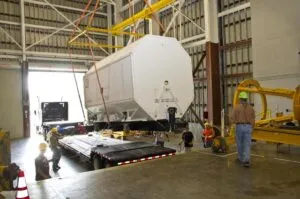
- Space Shuttle External Tank: SLA-561S was applied at localized ascent-heating spots, such as the liquid-hydrogen aft dome and tank interference-heating regions.
One common mix-up
SLA-561 is not the orange foam on the Space Shuttle’s tank. That foam is spray-on foam insulation (SOFI), a cryogenic insulator that keeps super-cold propellant cold and prevents ice. SLA-561 is an ablator built to survive entry heating. Both happened to be used on the Shuttle tank for different jobs. A related sister material, SLA-220, is tuned to form a glass-like char instead of a carbon one so radio signals can pass through it – useful where antennas must transmit through a heat shield.
Sprayable silicone elastomer with cork and silica fillers