

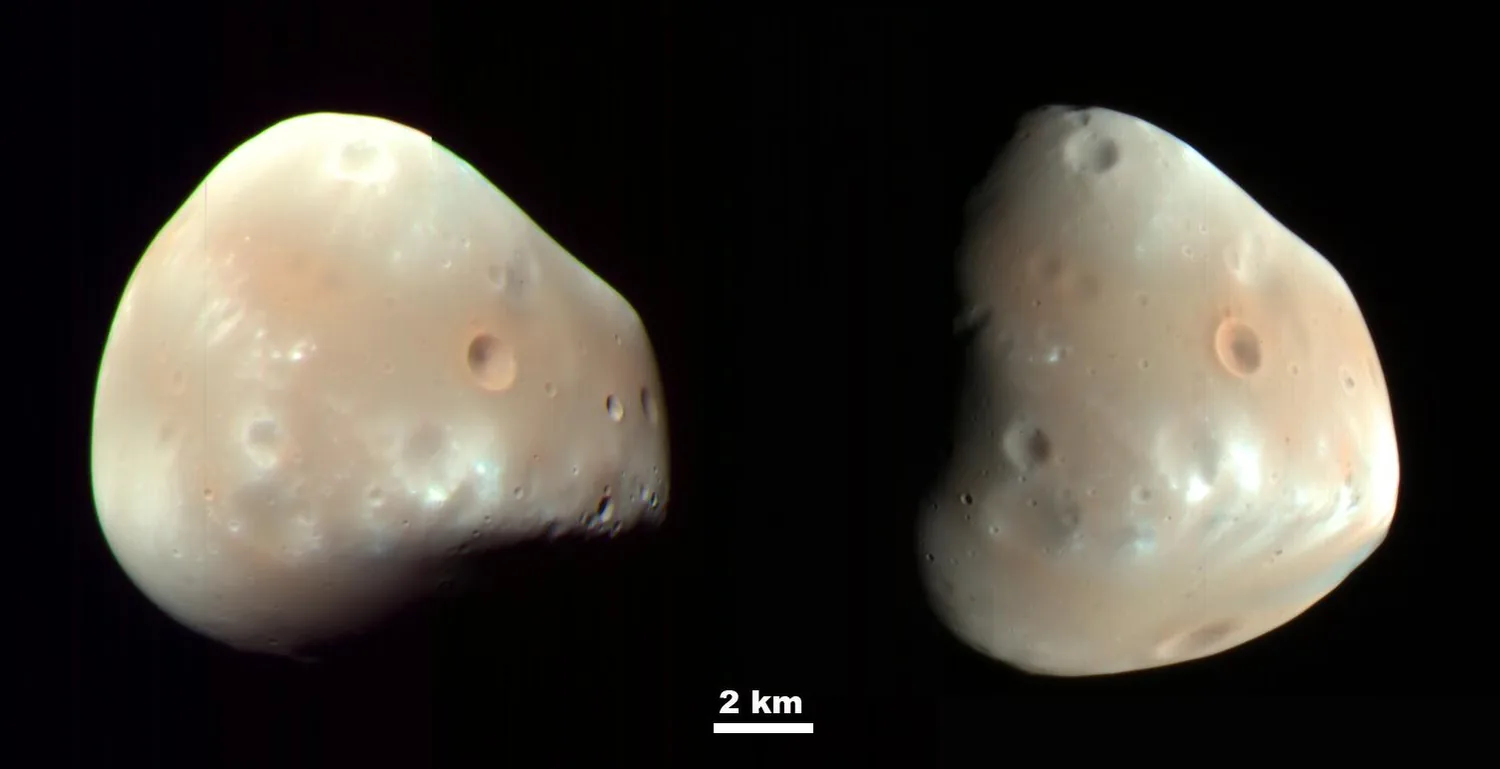
About Deimos
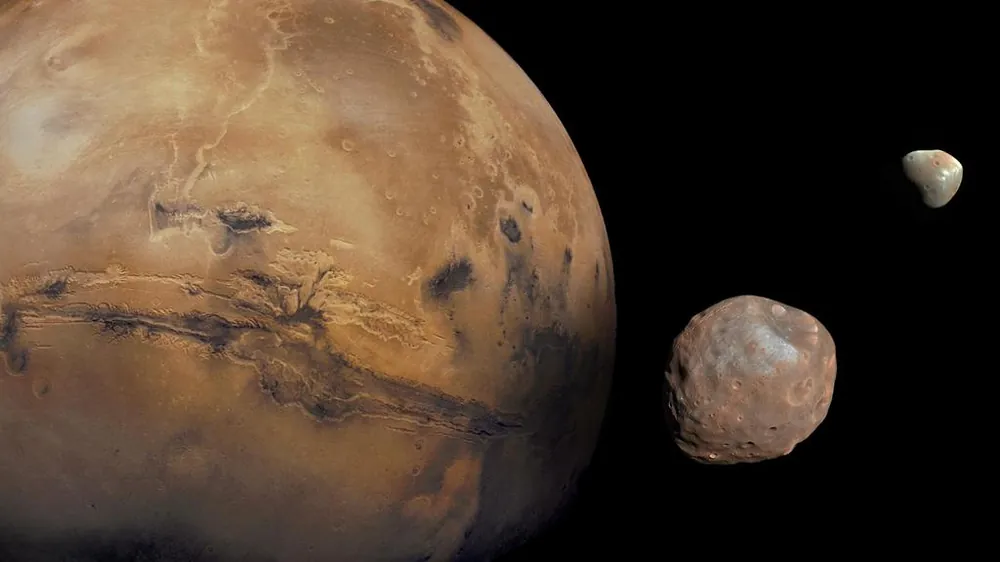
Deimos is the smaller and more distant of the two moons of Mars. Like Phobos, it was discovered by Asaph Hall in August 1877. It orbits Mars every 30.3 hours at an altitude of about 23,460 km.
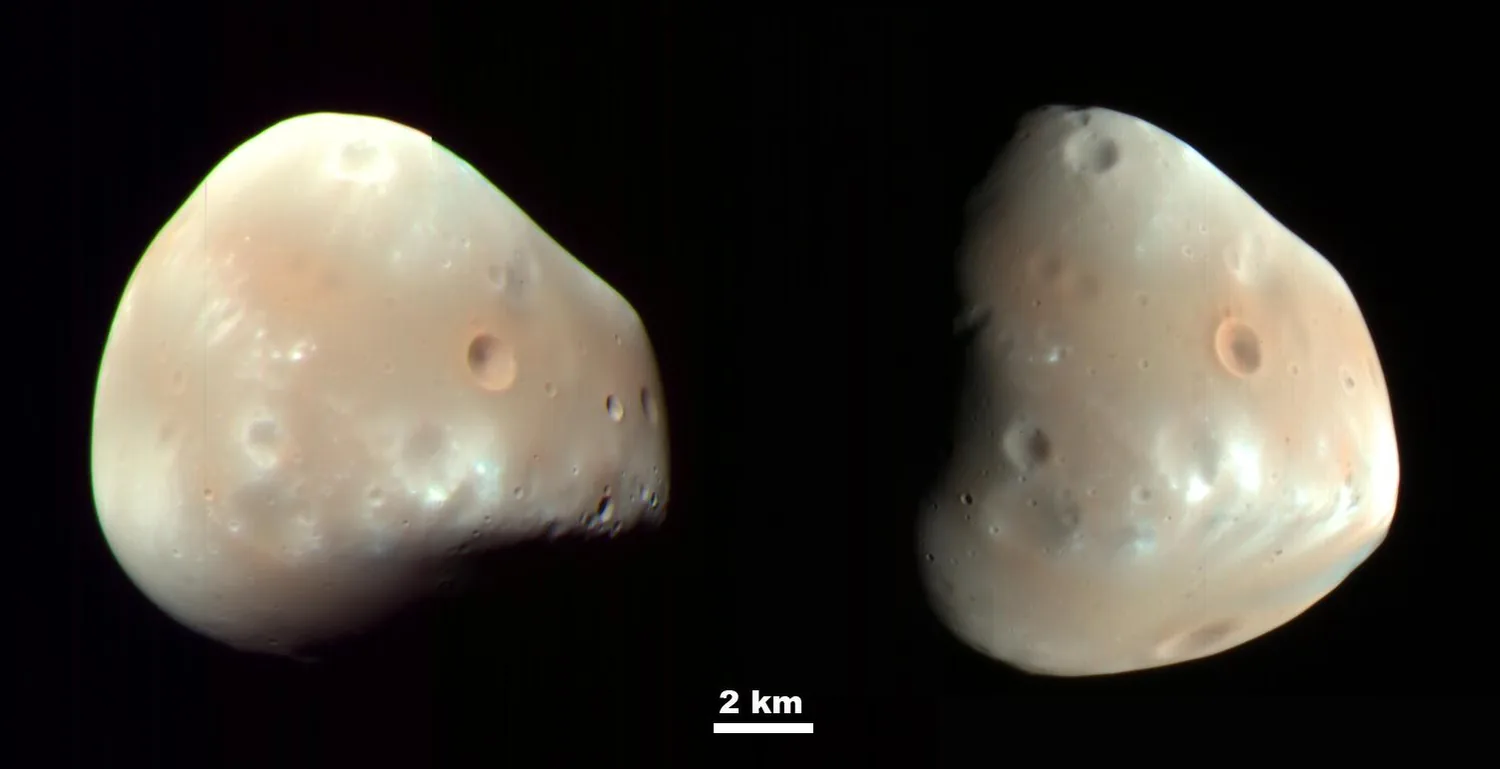
Deimos’s surface is far smoother in appearance than Phobos’s because a thick regolith partly fills its craters. Only two named craters exceed 2 km in diameter: Swift and Voltaire. In 2023 the UAE’s Hope orbiter captured the first detailed images of Deimos’s far side, revealing details of its trailing hemisphere never before seen.
Unlike Phobos, Deimos is outside Mars’s synchronous orbit, meaning tidal forces push it slowly outward — it will eventually escape Mars entirely. Its density and spectral properties are consistent with a C- or D-type carbonaceous asteroid, suggesting it may be a captured main-belt object rather than a body that formed in Mars’s orbit.
Physical Properties
Orbit
Gallery
Hand-picked mission imagery of Deimos sourced from NASA and partner archives. Click any photo for full resolution and source attribution.
Imagery on this page is provided by the original mission teams. Full attribution terms: Image Rights & Credits.
Sources & Further Reading
- NASA — official mission / factsheet page
- Wikipedia — extensive cross-referenced article
- NASA u2014 Deimos
- UAE Hope Mars Mission u2014 Deimos observations 2023
Numerical values (radius, mass, orbital elements, temperatures) are drawn from NASA NSSDC Planetary Fact Sheets, JPL Horizons, and the JPL Small-Body Database. Last refreshed: 2026-06-08 01:37:01.