

About Enceladus
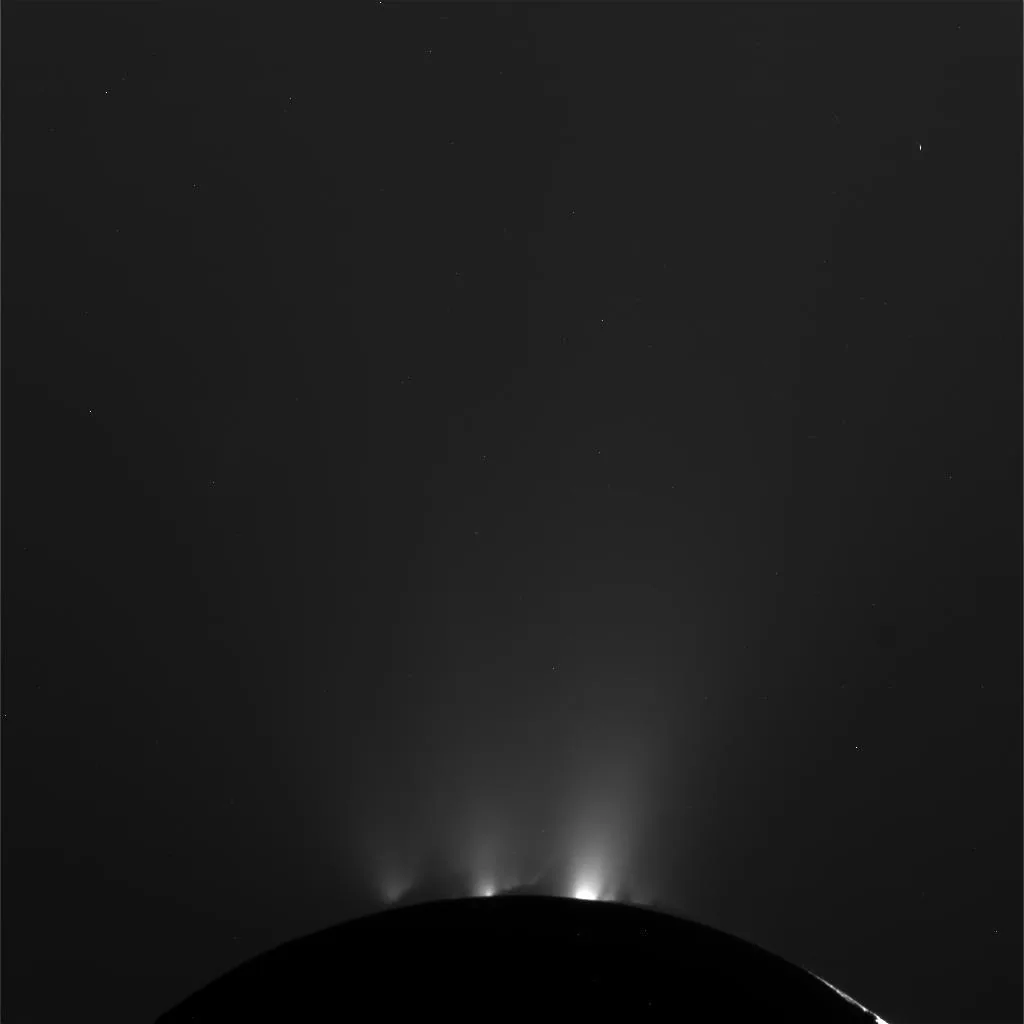
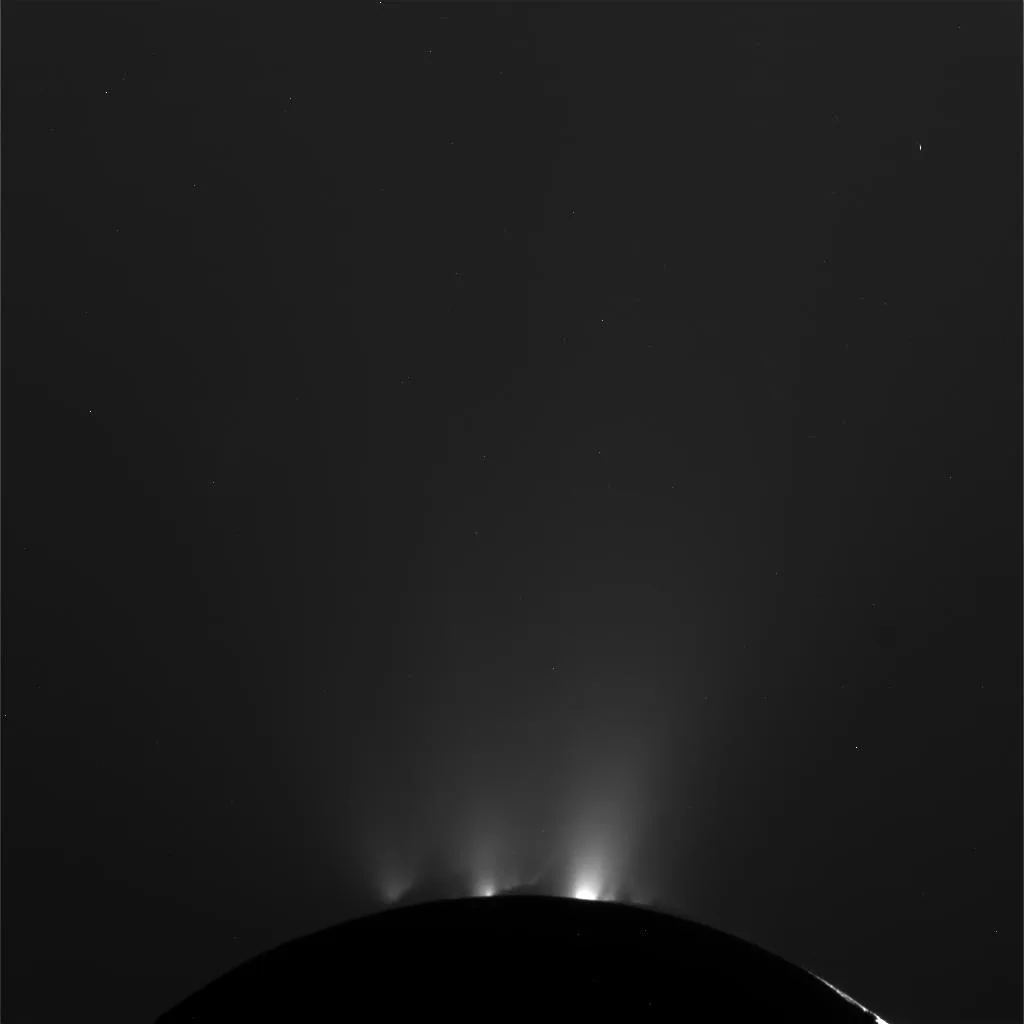
Enceladus is a small, brilliantly bright icy moon of Saturn — only about 500 km across — that has become one of the most astrobiologically significant worlds in the Solar System since Cassini discovered its active cryovolcanic plumes in 2005.
Four parallel fissures at Enceladus’s south pole, nicknamed the “tiger stripes,” continuously erupt jets of water vapor and ice grains. Cassini flew directly through these plumes several times, and mass spectrometer measurements revealed salt, silica nanoparticles (a signature of hot water interacting with rock), methane, carbon dioxide, ammonia, and complex organic molecules — exactly the chemistry needed for habitable environments.
Gravity measurements from Cassini’s flybys confirmed a global subsurface liquid-water ocean ~30-40 km deep beneath the icy crust. Material ejected from the plumes supplies Saturn’s diffuse E ring. NASA’s 2023 Planetary Decadal Survey identified “Enceladus Orbilander” as the highest-priority astrobiology flagship — a mission that would orbit Enceladus and then land to directly sample freshly-erupted ocean material.
Physical Properties
Orbit
Missions to Enceladus
1 spacecraft tracked on Space Launch Live.
Gallery
Hand-picked mission imagery of Enceladus sourced from NASA and partner archives. Click any photo for full resolution and source attribution.
Imagery on this page is provided by the original mission teams. Full attribution terms: Image Rights & Credits.
Sources & Further Reading
- NASA — official mission / factsheet page
- Wikipedia — extensive cross-referenced article
- NASA u2014 Enceladus
- NASEM Planetary Decadal Survey 2023-2032
- Cassini Mission u2014 Enceladus Plume Science
Numerical values (radius, mass, orbital elements, temperatures) are drawn from NASA NSSDC Planetary Fact Sheets, JPL Horizons, and the JPL Small-Body Database. Last refreshed: 2026-06-08 01:37:02.