

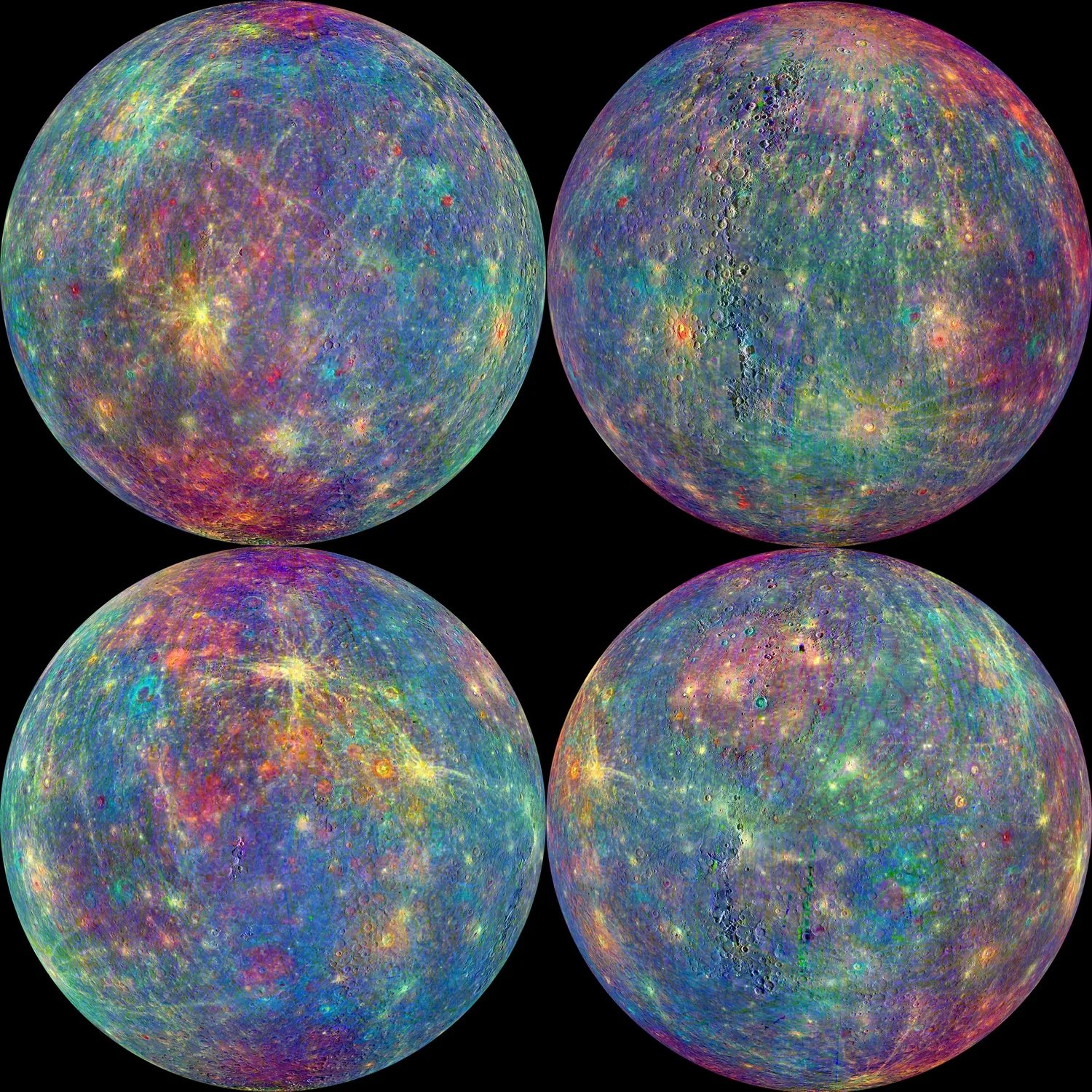
About Mercury
Mercury is the smallest and innermost planet of the Solar System. Despite being closest to the Sun, it is not the hottest planet — that distinction goes to Venus, which has a thick CO₂ atmosphere. Mercury’s essentially non-existent atmosphere (a tenuous exosphere of sodium, potassium, hydrogen and helium) lets heat escape rapidly; temperatures drop to ~100 K on the night side.
The planet is locked in a 3:2 spin-orbit resonance, meaning it rotates three times on its axis for every two orbits around the Sun. A single solar day on Mercury (sunrise to sunrise) lasts about 176 Earth days.
Mercury’s density (5.43 g/cm³) is second only to Earth’s and implies an enormous iron core making up some 85% of its radius. The Caloris Basin, 1,550 km across, is one of the largest impact features in the Solar System; antipodal to it lie the “weird terrain” hills thought to have formed when seismic waves from the impact converged on the opposite hemisphere. NASA’s MESSENGER mission (orbital phase 2011-2015) mapped the planet in detail and confirmed water ice in permanently shadowed polar craters. The ESA/JAXA BepiColombo spacecraft, launched in 2018, is scheduled to enter orbit in November 2026.
Physical Properties
Atmosphere Composition
- Oxygen 42%
- Sodium 29%
- Hydrogen 22%
- Helium 6%
- Potassium, Water vapor trace
Orbit
Missions to Mercury
2 spacecraft tracked on Space Launch Live.
Gallery
Hand-picked mission imagery of Mercury sourced from NASA and partner archives. Click any photo for full resolution and source attribution.
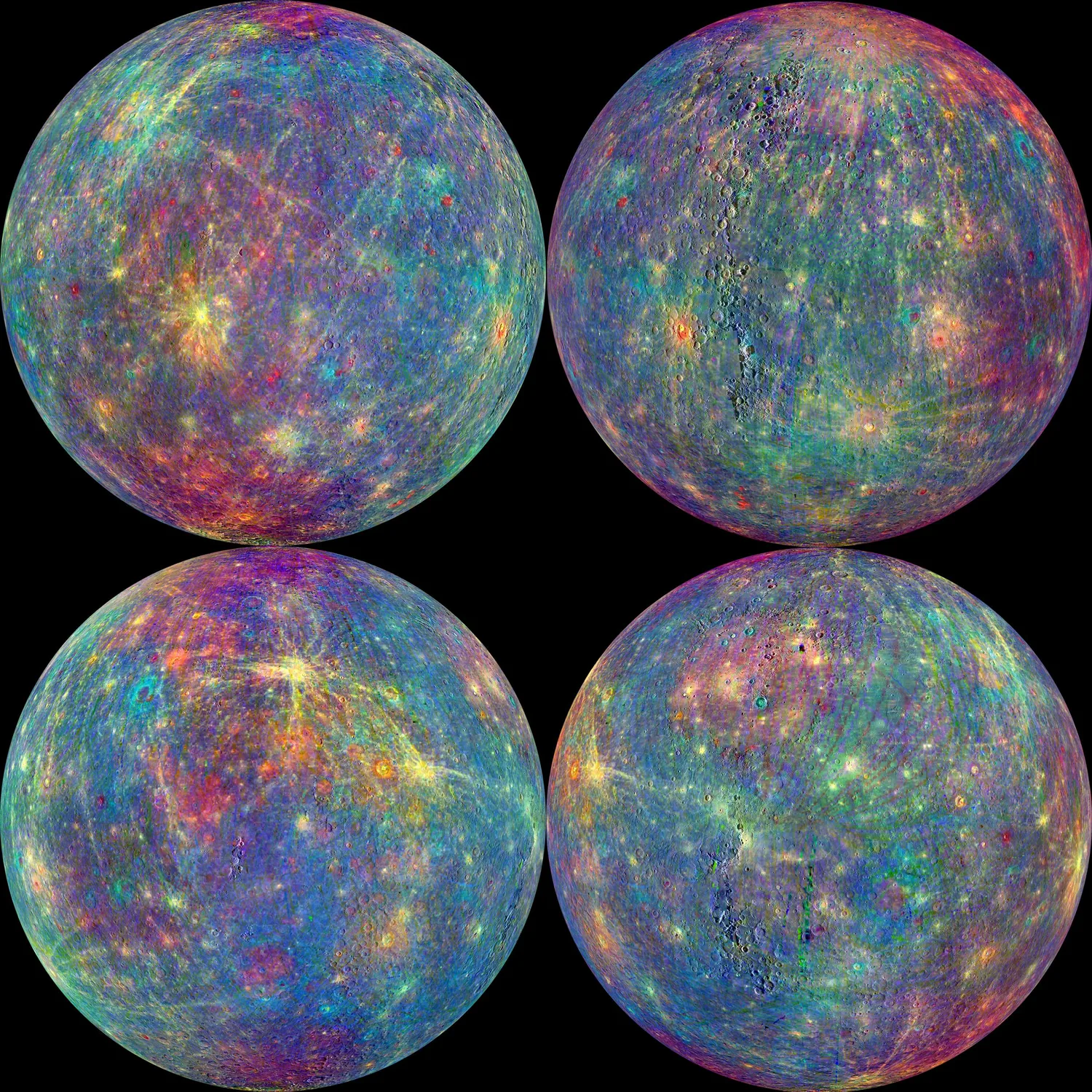
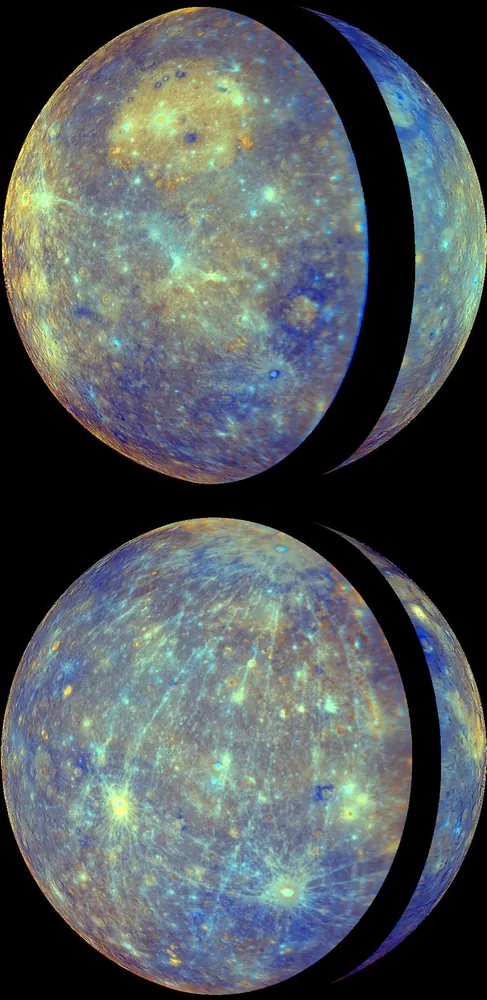
Imagery on this page is provided by the original mission teams. Full attribution terms: Image Rights & Credits.
Sources & Further Reading
- NASA — official mission / factsheet page
- NASA JPL — orbital data and imaging
- Wikipedia — extensive cross-referenced article
- NASA Mercury Fact Sheet (NSSDC)
- NASA u2014 Mercury
- MESSENGER Mission
- ESA/JAXA BepiColombo
Numerical values (radius, mass, orbital elements, temperatures) are drawn from NASA NSSDC Planetary Fact Sheets, JPL Horizons, and the JPL Small-Body Database. Last refreshed: 2026-06-08 01:37:01.