

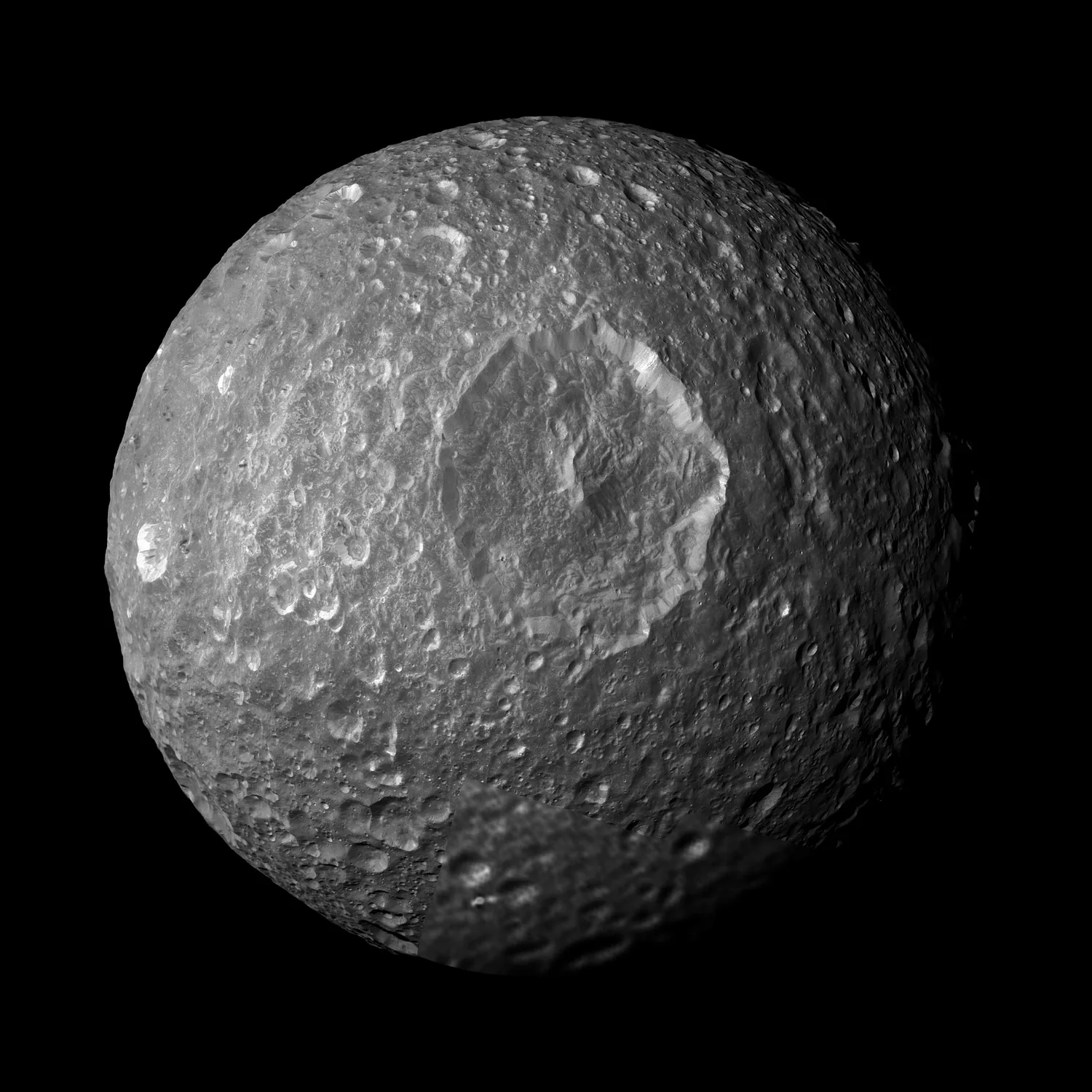
About Mimas
Mimas, the smallest and innermost of Saturn’s major moons, is dominated by the 139 km wide impact crater Herschel — so large relative to the moon that Mimas was nicknamed the “Death Star moon” after the original Star Wars film. The impact that formed Herschel very nearly shattered Mimas.
Its unusually low density suggests a bulk composition of mostly water ice with a small rocky core. A 2024 reanalysis of Cassini tracking data identified a libration pattern best explained by a young (5-15 million years old) subsurface liquid water ocean — a surprising result for so small and ancient-looking a body.
Physical Properties
Orbit
Gallery
Hand-picked mission imagery of Mimas sourced from NASA and partner archives. Click any photo for full resolution and source attribution.
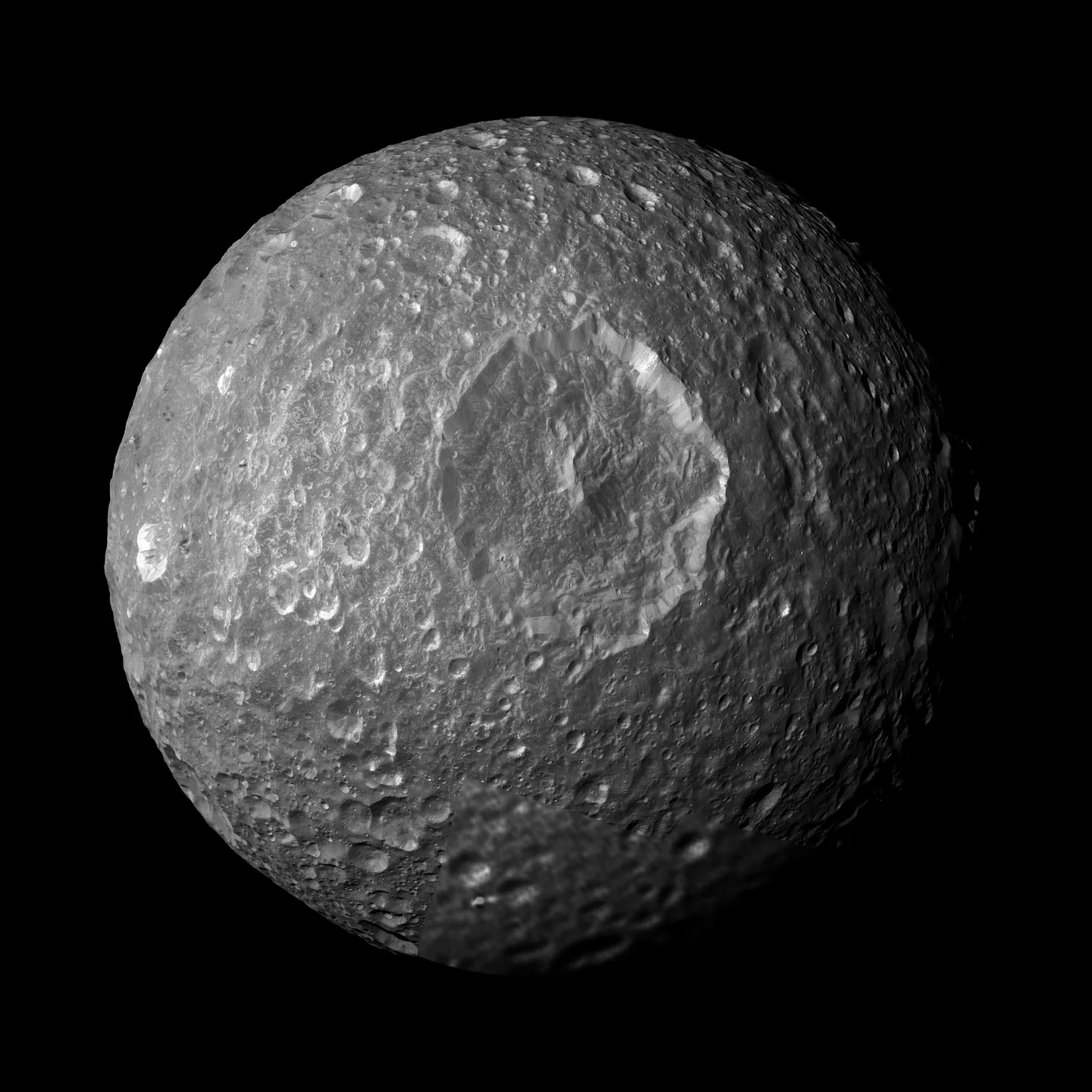

Imagery on this page is provided by the original mission teams. Full attribution terms: Image Rights & Credits.
Sources & Further Reading
- NASA — official mission / factsheet page
- Wikipedia — extensive cross-referenced article
- NASA u2014 Mimas
- Lainey et al., Nature 2024 u2014 Subsurface ocean of Mimas (2024)
Numerical values (radius, mass, orbital elements, temperatures) are drawn from NASA NSSDC Planetary Fact Sheets, JPL Horizons, and the JPL Small-Body Database. Last refreshed: 2026-06-08 01:37:02.