


About Phoebe
Phoebe is one of Saturn’s outer, irregular moons and the largest of them. Its retrograde, highly inclined orbit and C- to B-type spectral properties strongly suggest it was captured from the Centaur or Kuiper Belt population early in Saturn’s history. In 2009 NASA’s Spitzer Space Telescope discovered the enormous, tenuous Phoebe ring — by far the largest known planetary ring — dust ejected from Phoebe that slowly spirals inward and coats one hemisphere of the synchronously-rotating Iapetus.
Physical Properties
Orbit
Missions to Phoebe
1 spacecraft tracked on Space Launch Live.
Gallery
Hand-picked mission imagery of Phoebe sourced from NASA and partner archives. Click any photo for full resolution and source attribution.
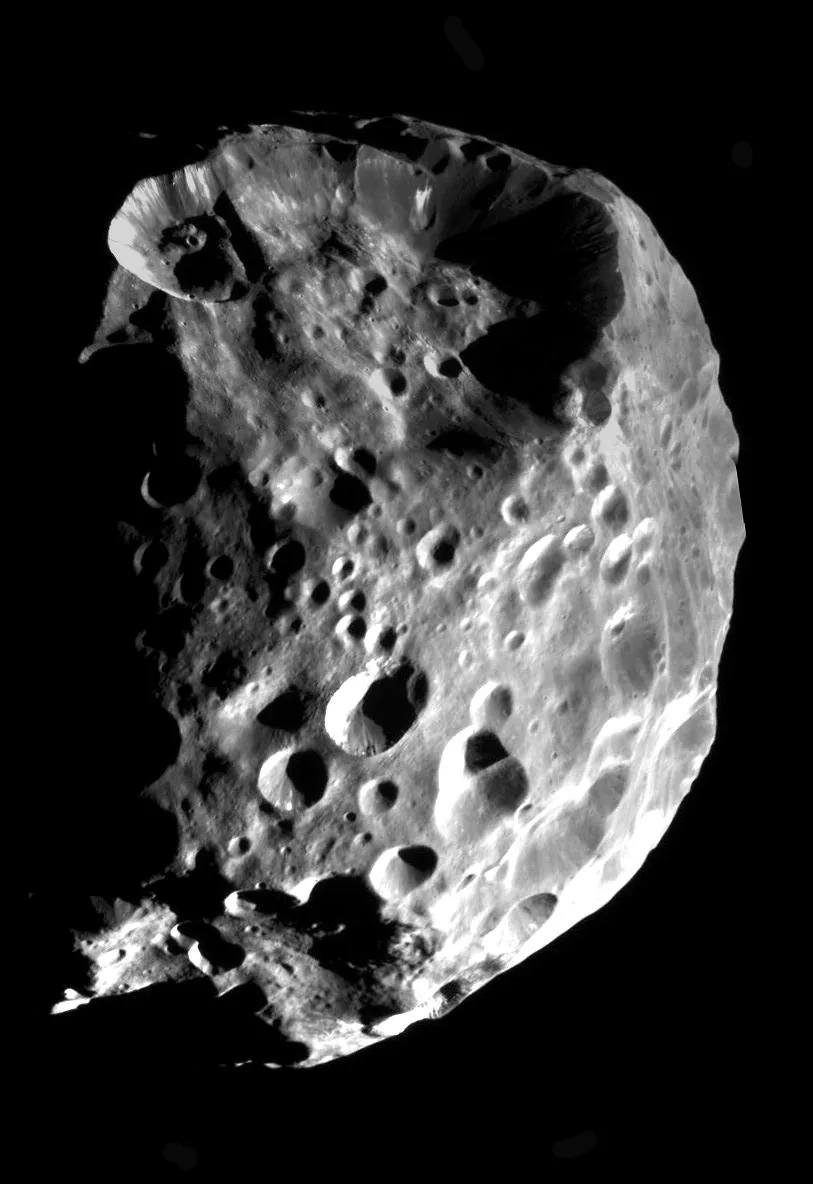

Imagery on this page is provided by the original mission teams. Full attribution terms: Image Rights & Credits.
Sources & Further Reading
- NASA — official mission / factsheet page
- Wikipedia — extensive cross-referenced article
- NASA u2014 Phoebe
Numerical values (radius, mass, orbital elements, temperatures) are drawn from NASA NSSDC Planetary Fact Sheets, JPL Horizons, and the JPL Small-Body Database. Last refreshed: 2026-06-08 01:37:02.