

About Titan
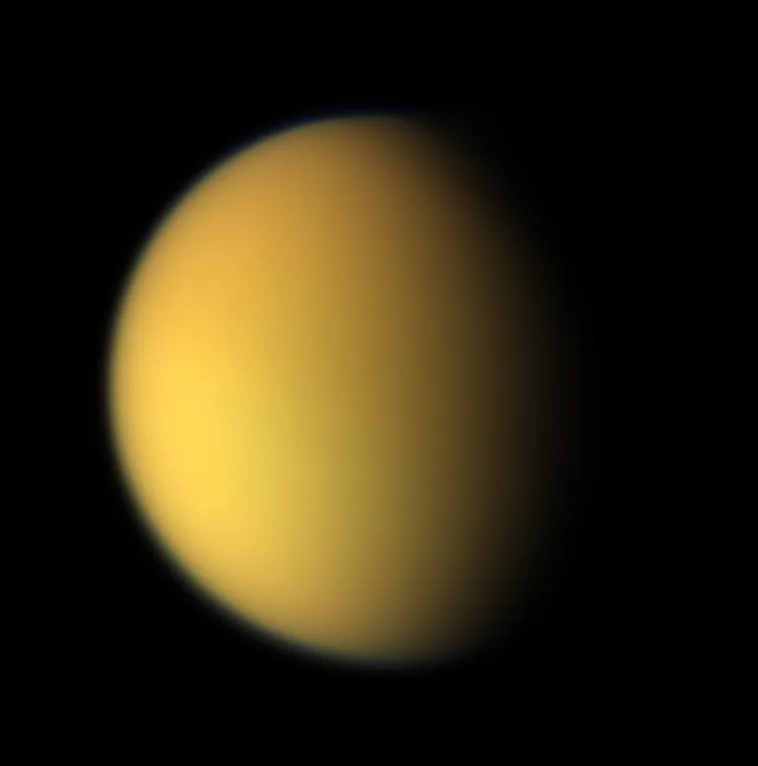
Titan is Saturn’s largest moon and the second-largest in the Solar System — larger in diameter than Mercury. It is the only moon known to have a substantial, dense atmosphere, composed mainly of nitrogen (94%) with methane (5.65%) and trace hydrocarbons. Surface pressure is 1.45 bar — 45% greater than Earth’s.
Titan is the only world besides Earth where stable bodies of liquid are known to exist on the surface. Its lakes and seas — Kraken Mare, Ligeia Mare, Punga Mare and hundreds of smaller lakes — are filled with liquid methane and ethane at 94 K. A full “hydrological” cycle operates: methane clouds rain onto highlands, carve river channels, and pool into seas.
Beneath the icy crust Titan likely hosts a subsurface water-ocean layer tens of kilometers thick. The Cassini-Huygens mission transformed our understanding: Cassini made 127 flybys between 2004-2017, and on 14 January 2005 its piggybacked European probe, Huygens, became the first (and only) spacecraft to land on an outer-solar-system moon. NASA’s Dragonfly — an 8-rotor drone — is scheduled to launch in 2028 and arrive at Titan in 2034 to fly between multiple scientifically diverse sites.
Physical Properties
Atmosphere Composition
- Nitrogen (Nu2082) 94.2%
- Methane (CHu2084) 5.65%
- Hydrogen, Argon, Ethane, Acetylene trace
Orbit
Missions to Titan
2 spacecraft tracked on Space Launch Live.
Gallery
Hand-picked mission imagery of Titan sourced from NASA and partner archives. Click any photo for full resolution and source attribution.
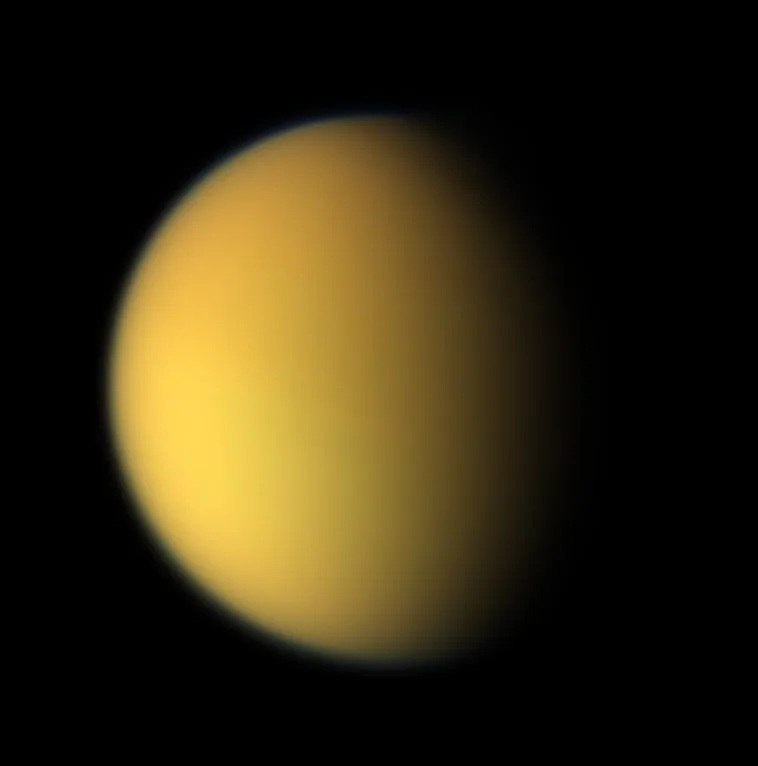
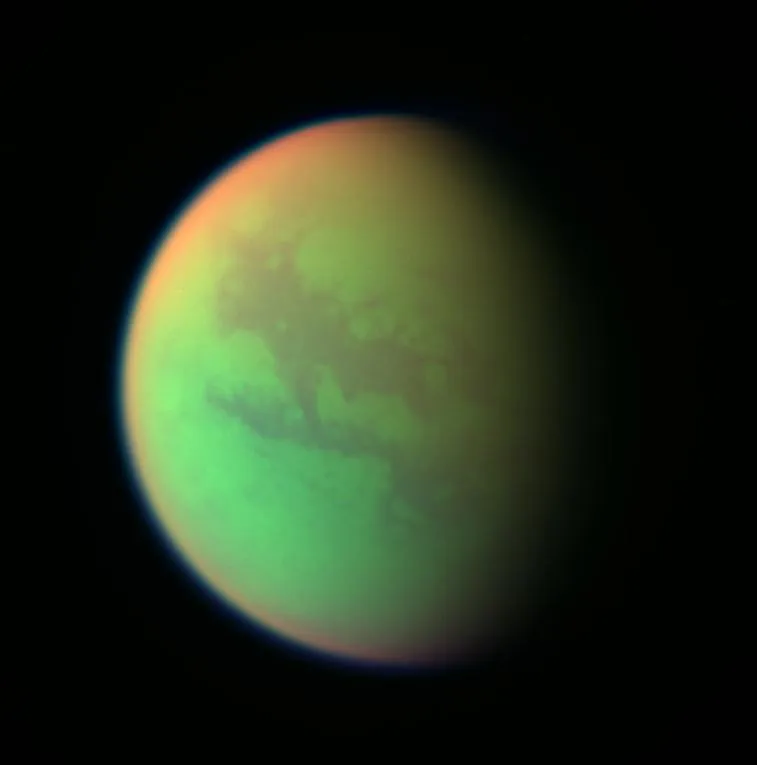
Imagery on this page is provided by the original mission teams. Full attribution terms: Image Rights & Credits.
Sources & Further Reading
- NASA — official mission / factsheet page
- Wikipedia — extensive cross-referenced article
- NASA u2014 Titan
- ESA Huygens Probe
- NASA Dragonfly
Numerical values (radius, mass, orbital elements, temperatures) are drawn from NASA NSSDC Planetary Fact Sheets, JPL Horizons, and the JPL Small-Body Database. Last refreshed: 2026-06-08 01:37:01.