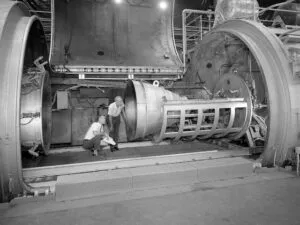
Propellant Valve Assembly
Typical Specifications
Operating Principle
A propellant valve assembly is the part of a rocket engine that decides whether fuel and oxidizer reach the place where they burn, and how fast they get there. It is the engine’s main gate, throttle, and emergency stop, all rolled into one.
Quick facts
- What it does: controls the flow of propellant (the fuel and the oxidizer, the chemical that lets the fuel burn) on its way from the tanks to the engine.
- Where it sits: between the propellant tanks or pumps and the injector, the part that sprays propellant into the combustion chamber where it burns.
- Common types: ball valves (often “full-port,” meaning the opening is as wide as the pipe to minimize pressure loss), poppet valves (lighter and cheaper), and butterfly/blade valves.
- How it is moved: by hydraulics (pressurized fluid), by pneumatic pressure (helium or nitrogen gas), or by electrical solenoids in small thrusters.
- Reference: NASA wrote an entire design guide about these parts, SP-8097, “Liquid Rocket Valve Assemblies” (1973).
What it is and how it works
In a liquid-propellant engine, an electrical or mechanical command moves the valve element, the moving piece inside, such as a ball, a poppet (a plug that lifts off a seat), or a disc. Moving it either opens the line or blocks it. The main valves route fuel and oxidizer from the tanks or from the turbopump (the pump that pressurizes the propellant) to the injector, which sprays them into the combustion chamber to atomize, mix, and burn.
These valves do more than switch flow on and off. A calibrated inlet orifice, a precisely sized hole, on each valve meters the flow so the engine runs at the correct mixture ratio, the balance of fuel to oxidizer. On engines that can throttle, the valve position is adjusted to change thrust. Think of it like the faucet, the mixing lever, and the shutoff for a sink, combined into one carefully tuned unit.
Opening and closing follow a strict timed sequence so the engine does not start roughly or spike in pressure. On the Saturn V’s F-1 engine, the oxidizer valves open first and mechanically trip the parts that start the gas generator. The fuel valves open only after fuel pressure and chamber pressure cross set thresholds: the igniter fuel valve lifts off its seat at about 375 psig of fuel pump discharge, and about 20 psig of chamber pressure trips the ignition monitor valve to open the main fuel valves. At shutdown the gas generator valve, then the oxidizer valves, then the fuel valves close in that order. Power to move the valves comes from hydraulics, gas pressure, or solenoids, often with a backup that can force the valves shut if the main system fails.
Small spacecraft thrusters handle propellant in a few different ways. Some use a single bipropellant valve that admits the fuel and the oxidizer to the injector at the same time, while others use a pair of separate fuel and oxidizer valves working together. Either way the propellants are usually hypergolic, meaning they ignite the instant they touch, so no separate igniter is needed.
Why it matters
Propellant valves are the main way an engine is commanded: they start it, stop it, throttle it, and hold the mixture ratio that keeps the burn steady and efficient. Because they handle high-pressure propellants that are often cryogenic (extremely cold) or corrosive, and must move reliably in milliseconds with exact timing, they are among the most reliability-critical parts of a propulsion system. A valve that sticks, leaks, or fires out of sequence can cause a hard start, unstable combustion, or loss of the vehicle. Designers weigh real trade-offs: ball valves give low pressure loss but add mass and complexity, while poppets are lighter and cheaper but must be balanced against pressure. They also work hard to seal against cold-temperature leaks and often add a redundant backup actuator for safety.
Notable examples
- RS-25 / Space Shuttle Main Engine: five hydraulically moved valves per engine, including the main oxidizer valve and main fuel valve. The preburner oxidizer valves work together to throttle the engine and hold a constant 6.03:1 mixture ratio, and in an emergency the engine’s helium supply can slam them shut.
- Rocketdyne F-1 (Saturn V): sequenced main oxidizer and main fuel valves that start and stop the engine.
- Apollo spacecraft reaction-control thrusters: paired hypergolic fuel and oxidizer valves that meter both propellants into the thruster injector.
- Main Oxidizer Shut-off Valve: a pneumatically piloted valve controlling liquid-oxygen flow.
- Moog cryogenic poppet valves: commercial valves for isolating and venting cold propellants.
One note on language: “propellant valve assembly” can mean a single main fuel or oxidizer valve, the full set of valves on an engine, or the combined valve hardware on a small thruster, depending on the context.