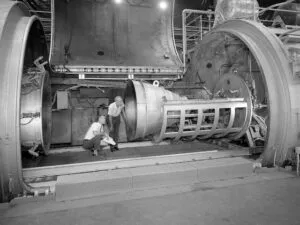
RS-25 HPOTP (High Pressure Oxidizer Turbopump)
Typical Specifications
Operating Principle
Deep inside the RS-25 rocket engine sits a pump roughly the size of a car engine — small enough that you could almost wrap your arms around it. It spins several times faster than a car engine revving hard, and it moves liquid oxygen with the force of thousands of horses.
Quick facts
- What it is: the High Pressure Oxidizer Turbopump (HPOTP), the part of the RS-25 engine that pushes liquid oxygen to very high pressure.
- Engine: the RS-25, better known as the Space Shuttle Main Engine (SSME), which burns liquid hydrogen and liquid oxygen.
- Size: about 600 by 900 mm (24 by 35 inches) — small enough to hold.
- Speed: about 28,120 rpm (rotations per minute).
- Power: about 23,260 horsepower (roughly 17.3 megawatts).
- Layout: two centrifugal pumps and a two-stage turbine on one shared shaft.
What it is and how it works
A turbopump is a pump driven by a turbine — a fan-like wheel spun by flowing gas. “Oxidizer” means the chemical that lets fuel burn; here it is liquid oxygen (LOX), oxygen chilled until it becomes a liquid. The HPOTP’s job is to take that liquid oxygen and raise its pressure enormously before it reaches the part of the engine where burning happens.
The RS-25 uses a staged-combustion cycle, meaning it burns a little propellant first in smaller chambers called preburners to make hot gas that drives the pumps, then burns the rest in the main combustion chamber. To feed all of this, pressures must be very high.
Liquid oxygen arrives already given a gentle boost by a companion pump, the low-pressure oxidizer turbopump (LPOTP). Inside the HPOTP, hot fuel-rich gas from the oxidizer preburner spins a two-stage turbine, which turns one shaft carrying two impellers (spinning wheels that fling liquid outward to pressurize it). The main impeller pushes most of the oxygen from about 2.9 to roughly 30 MPa (about 420 to 4,350 psi) for the main chamber. A second impeller on the same shaft takes about 11% of that flow and drives it even higher, to about 51 MPa (around 7,400 psi), to feed the preburners.
Here is the remarkable part. Hot gas spins the turbine just inches from liquid oxygen on the very same shaft — and any contact between oxygen and fuel would be catastrophic. To keep them apart, a cavity between the two sections is constantly flooded with helium gas, backed by seals, forming a clean barrier. If that helium pressure is ever lost, the engine shuts itself down automatically.
Why it matters
The HPOTP is one of the most power-dense turbomachines ever built: over 23,000 horsepower from a unit the size of a car engine, spinning at nearly 30,000 rpm inside freezing liquid oxygen. That power is what lets the RS-25 reach the high chamber pressures that make it so efficient. Think of it as the engine’s heart, pumping the oxidizer everything else depends on.
Its careful engineering — the helium-purged seals, the automatic shutdown, and the relentless focus on reliable, reusable parts — has become a benchmark for high-performance rocket pumps.
Where it is used and notable examples
- Space Shuttle Main Engine (SSME): the HPOTP is a core part of every RS-25. Three engines flew on each orbiter across 135 Shuttle missions from 1981 to 2011.
- Space Launch System (SLS): four RS-25 engines, each with its HPOTP, power the SLS core stage used on Artemis I (2022) and future Artemis missions.
- RS-25B / Block I: first flown on STS-70 in 1995, with improved high-pressure pumps using ceramic bearings, fewer rotating parts, and cast housings that removed many welds.
- Block II / Block IIA: further pump redesigns that improved reliability and operating margins for later Shuttle and SLS engines.
- Low-Pressure Oxidizer Turbopump (LPOTP): the companion pump that feeds the HPOTP, illustrating the low-then-high two-stage pumping used for both oxygen and hydrogen.
Figures here are nominal design values from NASA documentation; because the RS-25 can throttle and later versions run at higher power, treat the numbers as approximate.