TEA-TEB Ignition System
Typical Specifications
Operating Principle
Before a rocket roars to life, something has to light the fire. On many engines, that job belongs to TEA-TEB, a pair of liquids that burst into flame the instant they touch air.
Quick facts
- What it is: a chemical igniter that starts liquid-fueled rocket engines.
- The name: TEA = triethylaluminum, formula (C2H5)3Al; TEB = triethylborane, formula (C2H5)3B.
- Key behavior: both are pyrophoric (they ignite on contact with air or oxygen), and the mixture is hypergolic with liquid oxygen, meaning the two react and light the moment they meet, with no spark needed.
- Signature look: burns with an apple-green flame, typical of boron compounds.
- Some numbers: triethylborane boils at about 95 C (203 F), melts at -93 C, has a molar mass of 98.0 g/mol and density of 0.677 g/cm3, and can self-ignite at temperatures as low as about -20 C. Triethylaluminum boils higher, around 190 C.
- Single-use: each engine start consumes a fresh charge, so the number of relights is limited by how much is carried.
What it is and how it works
Think of TEA-TEB as a chemical match rather than a spark plug. Rocket fuels like RP-1 (a refined kerosene) do not light on their own when sprayed into a combustion chamber, the part of the engine where fuel and oxygen burn. So engineers inject a small “shot” of TEA-TEB to do the lighting for them.
In a typical SpaceX Merlin engine start, the sequence runs like this. First, liquid oxygen (LOX, oxygen chilled until it becomes a liquid) flows through the injector into the chamber. Next, a measured charge of TEA-TEB is injected, and on contact with the oxygen it spontaneously combusts. Finally, the main fuel, RP-1 kerosene, is admitted and is lit by the TEA-TEB flame, producing self-sustaining combustion that keeps burning on its own.
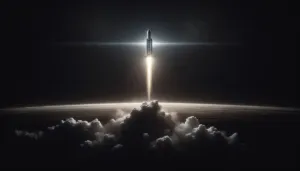
Because the ignition is purely chemical, no high-energy electrical spark system, exciter, or power supply is needed inside the chamber. The reaction with oxygen produces a brief green flash, from the boron in TEB, visible on Falcon 9 and Falcon Heavy launches an instant before the engines roar to life. The trade-off is simple: the charge is used up on each light, so the system cannot ignite an unlimited number of times.
Why it matters
TEA-TEB solves a stubborn problem. Many high-performance rocket and jet fuels, such as RP-1 kerosene and JP-7, are deliberately made low-volatility, meaning they do not evaporate or catch easily, which makes them hard to ignite. Spark igniters can fail in the extreme cold, vibration, and pressure of a rocket chamber. A pyrophoric igniter is simple, low in mass, and extremely reliable, which is why it has been used from the Apollo-era Saturn V through modern commercial rockets.
The limitations are real, though. TEA-TEB is a consumable that must be reloaded between flights, adding to the cost and turnaround time of each launch. Both chemicals ignite in ordinary air, so they must be stored and handled under an inert nitrogen blanket, and leaks are a fire hazard. And because each light expends a charge, the number of possible engine relights is capped, which matters for missions needing multiple burns or for rapid reuse. That mission-critical role showed in February 2023, when a Crew-6 launch was scrubbed after engineers could not confirm a full load of TEA-TEB ignition fluid.
Where it is used
- SpaceX Merlin 1D and Merlin Vacuum engines on Falcon 9 and Falcon Heavy: TEA-TEB ignites the first-stage engines at liftoff and supplies onboard cartridges for upper-stage and landing-engine relights, producing the signature green flash.
- Saturn V F-1 engines (Apollo program): a hypergolic cartridge of TEA-TEB, with TEB blended with about 10 to 15 percent TEA, ruptured to ignite the five first-stage engines before liftoff.
- Lockheed SR-71 Blackbird and A-12 OXCART: TEB ignited the hard-to-light JP-7 fuel in the Pratt & Whitney J58 engines, both for engine start and afterburner light.
- Firefly Aerospace Alpha rocket: its Reaver engines are ignited by a triethylaluminum-triethylborane mixture.
- In-space propulsion: NASA and industry have tested pyrophoric TEA-TEB-style ignition for restartable upper-stage and spacecraft engines.
Newer engines, such as SpaceX’s Raptor, are moving toward spark or torch igniters partly to allow many relights without a consumable, though those bring their own reliability challenges. For now, the green flash before liftoff remains one of spaceflight’s most recognizable signals that ignition has begun.