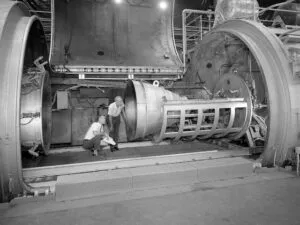
The CE-20 is India’s first high-thrust cryogenic rocket engine — a powerful upper-stage engine that burns supercold liquid hydrogen and liquid oxygen to push satellites into space. It is the engine that helped land Chandrayaan-3 near the Moon’s south pole.
Quick facts
- Built by: the Liquid Propulsion Systems Centre (LPSC) of the Indian Space Research Organisation (ISRO), manufactured with Hindustan Aeronautics Limited (HAL) at the Integrated Cryogenic Engine Manufacturing Facility in Bengaluru.
- Fuel and oxidizer: liquid hydrogen (LH2) as fuel, liquid oxygen (LOX) as the oxidizer that makes it burn — a highly efficient combination.
- Engine cycle: gas-generator (open) cycle — the first Indian cryogenic engine to use this design.
- Thrust in vacuum: about 186.36 kilonewtons nominal (often quoted as roughly 200 kN, or about 19 tonnes-force), adjustable across roughly 180–220 kN.
- Specific impulse (vacuum): about 442 seconds — a measure of fuel efficiency, and a high value as expected for LOX/LH2.
- Chamber pressure: about 6 megapascals (around 60 bar, or 870 psi).
- Dry mass: about 588 kg. Burn time: roughly 640–800 seconds.
- First flight: 5 June 2017, on the GSLV Mk III-D1 mission carrying the GSAT-19 satellite.
What it is and how it works
“Cryogenic” means the propellants are gases that have been chilled until they turn to liquid — liquid oxygen at about -183 °C and liquid hydrogen at about -253 °C. Cooling them this much packs far more fuel into a smaller tank. Burning hydrogen with oxygen releases a great deal of energy for each kilogram of propellant, which makes cryogenic engines very efficient. That efficiency is measured by specific impulse, a kind of “miles per gallon” for rockets; the CE-20’s roughly 442 seconds is high, which is why cryogenic engines are used on upper stages that fire in space to give satellites their final speed.
The CE-20 uses a gas-generator cycle. A small amount of the propellants is burned in a separate chamber called a gas generator to spin turbines. Those turbines drive pumps (turbopumps) that force the main hydrogen and oxygen into the engine’s combustion chamber at high pressure, where they ignite and rush out through a large bell-shaped nozzle (with an area ratio of 100) shaped for the vacuum of space. In this “open” cycle, the exhaust from the turbines is simply dumped overboard rather than fully reused. That is a little less efficient than more complex designs, but it is simpler and more robust — a deliberate trade-off ISRO made for this engine, and a different approach from the staged-combustion design of India’s earlier, smaller CE-7.5 cryogenic engine. The engine can also be throttled, meaning its thrust can be set to fixed levels, so ISRO has qualified it at 19, 20, and an uprated 22 tonnes for different missions.
Why it matters
Cryogenic propulsion is one of the hardest rocket technologies to master, and only a handful of nations have it. The CE-20 gives India its own heavy-lift capability without relying on foreign engines. It powers the upper stage of the LVM3 — India’s most powerful operational rocket — enabling launches to geostationary orbit, to the Moon, and for commercial satellite constellations. An uprated 22-tonne version is planned to lift heavier payloads, including modules for India’s future space station, the Bharatiya Antariksh Station.
Where it is used and notable examples
- LVM3 / GSLV Mk III: a single CE-20 powers the C25 cryogenic upper stage — about 4 m across and 13.5 m long, holding roughly 28 tonnes of liquid hydrogen and liquid oxygen.
- Chandrayaan-2 (2019) and Chandrayaan-3 (2023): India’s lunar missions, both launched by LVM3 with the CE-20 upper stage; Chandrayaan-3 achieved a soft landing near the lunar south pole.
- OneWeb constellation launches (from October 2022): commercial broadband satellites carried in batches (for example, 36 per mission), marking India’s entry into commercial heavy-lift launch.
- Gaganyaan: India’s first crewed spaceflight program, for which a human-rated CE-20 (qualified at 20 tonnes of thrust) is being certified; the human-rating milestone was reached in early 2024.