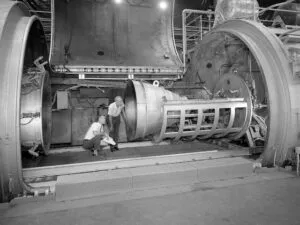
The RD-170 is the most powerful liquid-fuel rocket engine ever flown. Built in the Soviet Union, it solved an engineering puzzle that American designers had studied and set aside as too hard.
Quick facts
- Maker: NPO Energomash (the Glushko Design Bureau), USSR/Russia.
- Fuel and oxidizer (propellants): liquid oxygen plus RG-1 kerosene. The oxidizer is the chemical that lets the fuel burn.
- Thrust (pushing force): about 7,250 kN (1,630,000 lbf) at sea level, rising to about 7,900 kN in the vacuum of space.
- Combustion chambers: four, all fed by a single turbopump (the spinning pump that forces propellants in).
- Specific impulse (a measure of fuel efficiency): 309 seconds at sea level, 337 seconds in vacuum.
- Chamber pressure: about 24.5 MPa (roughly 3,556 psi).
- Turbopump power: roughly 170 to 190 MW (about 230,000 to 257,000 horsepower).
- Dry mass: about 9,750 kg. Length about 4 m, diameter about 3.8 m.
- Burn time: about 150 seconds; throttle range 40 to 100 percent; designed for reuse up to 10 flights.
- History: first test firing August 25, 1980; flew on the Energia rocket in 1987 and 1988.
What it is and how it works
Development began in 1976 under chief designer Valentin Glushko. The RD-170 uses an oxidizer-rich staged combustion cycle, also called a closed cycle. Here is the idea. Two small chambers called preburners burn nearly all the liquid oxygen with a little kerosene to make hot, oxygen-rich gas. That gas spins one enormous single-shaft turbine, which drives the turbopump that shoves propellants in at very high pressure.
The clever part comes next. In a simpler gas-generator engine, the turbine’s exhaust is dumped overboard and wasted. The RD-170 instead routes that exhaust into the main chambers to burn with the rest of the fuel, so almost nothing is thrown away. That is what makes it so efficient.
One single chamber that big would shake itself apart from combustion instability, a violent rattling of the burning gases. So the design splits the thrust across four smaller chambers, each with its own nozzle, all fed by that one giant pump. Think of it as one powerful engine block driving four cylinders rather than one oversized cylinder that would tear itself to pieces. The chambers swivel, or gimbal, to steer the rocket.
Why it matters
Hot, high-pressure oxygen normally corrodes bare metal almost the instant it touches it, which is why American engineers had studied oxidizer-rich staged combustion and judged it too difficult. The Soviets made it work using special alloys and inert enamel coatings on exposed surfaces. The result was world-leading thrust-to-weight and efficiency for a kerosene-and-oxygen engine.
The achievement was striking enough that in the 1990s U.S. companies, at first doubtful the published numbers could be real, imported Russian engines to test them. The four-chambers-one-turbopump layout then became the template for an entire family of engines still flying today, making the RD-170 one of the most influential rocket engines ever built.
Where it is used and notable examples
- Energia: the Soviet super-heavy launcher carried one RD-170 on each of its four strap-on boosters, four in total. It flew twice, carrying Polyus in 1987 and the Buran shuttle in 1988.
- Zenit family: powered by the RD-171, a near-twin with two-axis gimballing, across dozens of launches including Sea Launch’s Zenit-3SL.
- Atlas V (USA): used the RD-180, a two-chamber “half” derivative, on its first stage for national-security and NASA missions.
- Angara family (Russia): uses the RD-191, a single-chamber derivative.
- Antares (USA): earlier versions used the RD-181 from the same lineage. The modernized, all-Russian RD-171MV now powers the new Soyuz-5 rocket.
The trade-off is weight and complexity: at about 9.75 tonnes dry it is the heaviest liquid engine, mechanically demanding to build, and reliant on exotic materials to survive its hot oxygen-rich gas.
| Thrust (Sea Level) | 7,257 kN (1,631,000 lbf) kN |
| Thrust (Vacuum) | 7,904 kN (1,777,000 lbf) kN |
| ISP (Sea Level) | 309 s s |
| ISP (Vacuum) | 337 s s |
| Chamber Pressure | 24.5 MPa (3,553 psi) bar |
| Mass | 9 kg |
| Thrust-to-Weight | 83 |
| Throttle Range | 56–100% |
| Restart Capable | No |
| Kilonewtons | 7.0 kN |
| Pounds-force | 1,574 lbf |
| Propellant | RP-1 |
| Oxidizer | LOX |
| Engine Cycle | Oxygen-Rich Staged Combustion |
| Mixture Ratio | 2.63:1 |
| Flow Rate | ~2,393 kg/s kg/s |
| Dimensions | 4.0 m diameter × 3.78 m length |
| Combustion Chambers | 4 |
| Nozzle Expansion Ratio | 36.87:1:1 |
| Manufacturer | NPO Energomash |
| Country | Russia / USSR |
| Status | Retired |
| First Flight | September 11, 1985 |
- RD-170
- RD-171
- RD-171M
- Energia
- Zenit-2
- Zenit-3SL