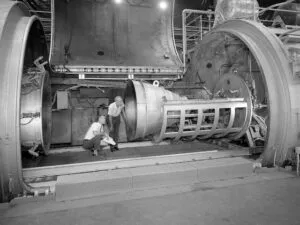
The RS-68A is a powerful American rocket engine that burned liquid hydrogen and liquid oxygen to lift some of the United States’ heaviest rockets off the ground. For more than a decade it was the muscle behind the Delta IV Heavy, and it remains the most powerful hydrogen-fueled rocket engine ever to fly.
Quick facts
- Type: liquid-fueled rocket engine that burns liquid hydrogen (LH2) as fuel and liquid oxygen (LOX) as the oxidizer (the substance that lets the fuel burn).
- Engine cycle: gas-generator (open) cycle.
- Thrust: about 705,000 pounds of force at sea level (3,137 kilonewtons) and about 800,000 pounds of force in the vacuum of space (3,560 kilonewtons).
- Specific impulse (Isp), a measure of fuel efficiency: about 411.9 seconds in vacuum, about 362 seconds at sea level.
- Throttle range: 58% to 102% of rated thrust; it pivots (gimbals) using hydraulics to steer the rocket.
- Mass: about 6,740 kilograms (14,870 pounds), with a thrust-to-weight ratio near 47:1.
- Size: about 5.20 meters (17.1 feet) long and 2.43 meters (8 feet) across.
- Maker: Pratt & Whitney Rocketdyne (until 2013), then Aerojet Rocketdyne (now part of L3Harris).
- Service: first hot-fire test September 2008; certified April 2011; first flight 29 June 2012; final flight 9 April 2024.
What it is and how it works
The RS-68A is the upgraded, higher-performance version of the RS-68, which was the first all-new large U.S. liquid rocket engine developed in roughly 25 years. It uses a gas-generator cycle, an “open” design in which a small fraction of the propellants is burned to drive the pumps, then thrown away.
Here is the idea. A rocket engine needs to force enormous amounts of fuel and oxidizer into its combustion chamber at high pressure. To do that, the RS-68A burns about 2 to 3 percent of its hydrogen and oxygen in a separate small chamber called a gas generator. The hot gas from that spins turbopumps, which are pumps driven by a turbine, like a tiny windmill pushing the main propellant flow. That turbine exhaust is then dumped overboard rather than reused. This open-cycle approach is mechanically simpler and cheaper to build than the closed staged-combustion cycle used by engines like the Space Shuttle Main Engine, at the cost of some efficiency.
Keeping the engine from melting is its own challenge. The main combustion chamber is regeneratively cooled, meaning cold propellant flows through channels in the walls to soak up heat before it burns. The large nozzle extension is ablatively cooled: its inner lining is designed to char and erode slightly, carrying heat away as it wears, much like a heat shield. Because that lining is consumed a little each flight, the engine suits single-use rockets.
One striking detail at liftoff is the fireball. As the engine starts, leftover hydrogen ignites and briefly engulfs the base of the rocket. It looks alarming, but it is expected, and the rocket’s orange insulating foam is built to withstand it.
Why it matters
For over a decade the RS-68A powered America’s heaviest operational launch vehicle, the Delta IV Heavy, which carried the nation’s most sensitive payloads. As the most powerful hydrogen-fueled engine ever flown, it gave that rocket the performance to lift large national-security satellites and high-energy deep-space probes.
Its story matters for cost reasons too. The parent RS-68 was developed largely with company money on a tight schedule, with a deliberate focus on low cost and simplicity and far fewer parts than the Space Shuttle Main Engine. That demonstrated a more affordable model for U.S. engine development. The RS-68A upgrade then raised sea-level thrust from about 663,000 pounds of force to about 705,000, increasing Delta IV Heavy payload capacity by roughly 8 to 13 percent and keeping the rocket competitive for the most demanding missions until its 2024 retirement. The trade-off was a modest vacuum efficiency (about 412 seconds) compared with the closed-cycle Space Shuttle Main Engine (about 452 seconds), an acceptable price for affordability on an expendable booster.
Where it was used and notable examples
- Delta IV Heavy: used three RS-68A engines, one on each of its three Common Booster Cores, for a combined liftoff thrust exceeding 2 million pounds of force.
- Delta IV Medium variants: earlier members of the family used a single RS-68 or RS-68A on the first stage.
- Exploration Flight Test-1 (5 December 2014): a Delta IV Heavy launched NASA’s first uncrewed Orion spacecraft on its inaugural test flight.
- Parker Solar Probe (12 August 2018): launched by Delta IV Heavy on its mission to fly through the Sun’s corona.
- National Reconnaissance Office missions: the Delta IV Heavy flew numerous classified payloads, which made up the bulk of its later flights, including its final flight on 9 April 2024 carrying NROL-70.
| Thrust (Sea Level) | 3,137 kN (705,300 lbf) kN |
| Thrust (Vacuum) | 3,560 kN (800,000 lbf) kN |
| ISP (Sea Level) | 362 s s |
| ISP (Vacuum) | 412 s s |
| Chamber Pressure | 10.26 MPa (1,488 psi) bar |
| Mass | 6 kg |
| Thrust-to-Weight | 54 |
| Throttle Range | 57–102% |
| Restart Capable | No |
| Kilonewtons | 3.0 kN |
| Pounds-force | 674 lbf |
| Propellant | Liquid Hydrogen (LH₂) |
| Oxidizer | LOX |
| Engine Cycle | Gas Generator |
| Mixture Ratio | 6:1 |
| Flow Rate | ~880 kg/s kg/s |
| Dimensions | 2.44 m diameter × 5.2 m length |
| Combustion Chambers | 1 |
| Nozzle Expansion Ratio | 21.5:1:1 |
| Manufacturer | Aerojet Rocketdyne |
| Country | United States |
| Status | Retired (with Delta IV) |
| First Flight | January 1, 1970 |
- RS-68
- RS-68A
- Delta IV
- Delta IV Heavy