The Saturn V was the giant rocket that carried astronauts to the Moon. Standing 363 feet tall and never losing a payload across 13 flights, it remains one of the most powerful machines humans have ever launched.
Quick facts
- Type: Three-stage, liquid-fueled expendable rocket (each section is used once and then discarded)
- Height: 363 feet (111 meters) fully stacked — taller than the Statue of Liberty
- Liftoff mass: roughly 2.8 to 3.0 million kilograms (about 6.2 to 6.5 million pounds)
- Liftoff thrust: about 7.6 million pounds of force (the pushing power that lifts the rocket)
- Payload: about 140,000 kg (310,000 lb) to low Earth orbit; about 43,500 kg (95,900 lb) sent toward the Moon
- Flights: 13 total, from November 9, 1967 (Apollo 4) to May 14, 1973 (Skylab 1)
- Developed by: NASA’s Marshall Space Flight Center in Huntsville, Alabama, led by engineer Wernher von Braun
What it is and how it works
A rocket has to escape Earth’s gravity while carrying enormous amounts of fuel. The Saturn V solved this with three stacked stages that fired one after another and dropped away once empty, shedding dead weight so the rest could keep speeding up. Think of it like a sprinter who sheds a heavy backpack mid-race to run faster.
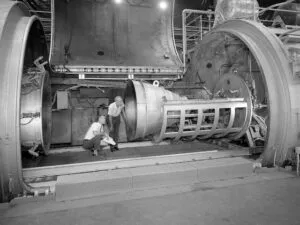
The first stage, called the S-IC, used five F-1 engines burning kerosene and liquid oxygen (oxygen chilled until it becomes a liquid, needed because there is no air in space to feed the flames). These five engines lifted the whole 6.5-million-pound stack off the launch pad and pushed it to about 42 miles up in roughly two and a half minutes.
The second stage, the S-II, used five J-2 engines burning liquid hydrogen and liquid oxygen, carrying the vehicle to the edge of space. The third stage, the S-IVB, used a single J-2 engine that could restart: it first fired to reach orbit around Earth, then re-ignited a couple of hours into the flight for the Trans-Lunar Injection burn — the push that accelerated the Apollo spacecraft to nearly 25,000 mph and aimed it at the Moon. A ring of guidance electronics built by IBM, called the Instrument Unit, sat atop the stages and steered the whole rocket.
Why it matters
The Saturn V was the machine that made crewed Moon landings possible, fulfilling President Kennedy’s goal of landing a person on the Moon before 1970. It became the decisive engineering achievement of the Apollo program and the Space Race. Its records for size, mass, and payload stood for more than half a century, and it gave humanity its only crewed flights beyond low Earth orbit. Across 13 launches it never lost a payload — a record that makes it the benchmark against which every later super-heavy rocket, including the Space Shuttle, NASA’s SLS, and SpaceX’s Starship, is still measured.
Notable flights and engines
- Apollo 8 (December 1968): the first crewed Saturn V to leave Earth orbit, sending three astronauts around the Moon for the first time.
- Apollo 11 (July 1969): the Saturn V that launched Neil Armstrong, Buzz Aldrin, and Michael Collins on the first crewed Moon landing.
- Skylab 1 (May 1973): the final Saturn V launch, a two-stage variant that placed America’s first space station into orbit instead of a lunar payload.
- F-1 engine: the Rocketdyne-built first-stage engine — the most powerful single-chamber liquid-fueled rocket engine ever flown, with five clustered together in the first stage.
- J-2 engine: the hydrogen-and-oxygen upper-stage engine, used five at a time on the second stage and singly on the restartable third stage.
Trade-offs and close calls
The Saturn V was fully expendable, throwing away three large stages and 11 engines on every flight. That made each launch enormously costly and is a major reason later programs pursued reusable rockets. The vehicle also survived some dramatic moments: Apollo 12 (1969) was struck by lightning twice shortly after liftoff yet flew on safely, and Apollo 13 (1970) suffered violent vibrations called pogo oscillations that shut down a second-stage engine early, with the remaining engines compensating. Through all of it, no Saturn V ever lost its payload. Three Saturn Vs survive today as museum displays — assembled from real flight hardware and ground-test stages — at Kennedy Space Center, Johnson Space Center, and the U.S. Space and Rocket Center.
| 🚀 Apollo 11 u2013 First Moon landing |
| 🚀 Apollo 13 u2013 Successful failure |
| 🚀 Skylab launch |
| Category | Launch Vehicle |
| Era | Space Race |
| Agency | NASA |
| Country | United States |
| Start Date | 1967-11-09 |
| End Date | 1973-05-14 |
| Total Flights | 13 |
| Success Rate | 100% |
| Successor | Space Launch System (SLS) |
| Original Cost | $6.42 billion |
| Inflation-Adjusted | $49.9 billion (2020) |