The Falcon 9 program turned a long-held dream of spaceflight into everyday reality: a rocket that lands itself and flies again. Built by SpaceX and first launched in 2010, Falcon 9 made reusable rockets routine and dramatically lowered the cost of reaching orbit, reshaping the entire launch industry.
Quick facts
- First flight: 2010, by SpaceX.
- Type: a two-stage rocket burning kerosene and liquid oxygen.
- Breakthrough: a first stage that returns and lands upright for reuse, first achieved in December 2015.
- Current version: Falcon 9 Block 5, designed for rapid, frequent reflights.
- Main jobs: launching Starlink internet satellites, commercial and government payloads, and Crew Dragon astronaut flights.
How reuse works
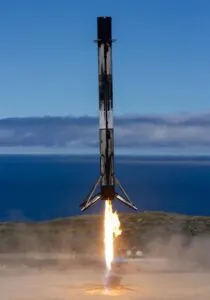
A traditional rocket is thrown away after one flight, like scrapping an airliner after a single trip. Falcon 9 changed that. After boosting its upper stage toward orbit, the first stage flips around, relights its engines, and steers back to a landing, either on solid ground or on a floating drone ship at sea, settling down on four legs. SpaceX then inspects, refurbishes, and flies the same booster again, with some individual boosters now flying well over a dozen times.
Why it matters
By reusing the most expensive part of the rocket, Falcon 9 cut launch costs and allowed launches at a pace never seen before, flying dozens of times a year. That cheap, frequent access to space made the giant Starlink internet constellation possible and returned human spaceflight to American soil in 2020, when Crew Dragon carried astronauts to the International Space Station. Falcon 9’s success proved reusability works and pushed the whole industry to follow, making it one of the most influential rockets ever built.
| 🚀 CRS-1 u2013 First ISS cargo |
| 🚀 Crew Demo-2 u2013 First crewed flight |
| 🚀 First booster landing (2015) |
| 🚀 Transporter rideshare missions |
| Category | Launch Vehicle |
| Era | Commercial |
| Agency | SpaceX |
| Country | United States |
| Start Date | 2010-06-04 |
| Total Flights | 300 |
| Success Rate | 99% |
| Successor | Starship |
| Original Cost | Proprietary |
| Inflation-Adjusted | ~$67M per launch (commercial) |