


Atlas V 551 | New Horizons
New Horizons is an interplanetary space probe that was launched as a part of NASA’s New Frontiers program. Engineered by the Johns Hopkins University Applied Physics Laboratory (APL) and the Southwest Research Institute (SwRI), with a team led by S. Alan Stern, the spacecraft was launched in 2006 with the primary mission to perform a flyby study of the Pluto system in 2015, and a secondary mission to fly by and study one or more other Kuiper belt objects (KBOs) in the decade to follow. It is the fifth artificial object to achieve the escape velocity needed to leave the Solar System.
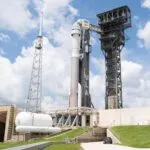
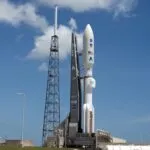
Atlas V is an expendable launch system in the Atlas rocket family. It was formerly operated by Lockheed Martin and is now operated by United Launch Alliance (ULA), a joint venture with Boeing. Each Atlas V rocket uses a Russian-built RD-180 engine burning kerosene and liquid oxygen to power its first stage and an American-built RL10 engine burning liquid hydrogen and liquid oxygen to power its Centaur upper stage. The RD-180 engines are provided by RD Amross, while Aerojet Rocketdyne provides both the RL10 engines and the strap-on boosters used in some configurations. The standard payload fairing sizes are 4 or 5 meters in diameter and of various lengths. Fairings sizes as large as 7.2 m in diameter and up to 32.3 m in length have been considered. The rocket is assembled in Decatur, Alabama and Harlingen, Texas.
When is the Atlas V 551 | New Horizons launch?
What rocket is being used for New Horizons?
Where is the Atlas V 551 | New Horizons launching from?
What orbit is New Horizons going to?
Who is launching New Horizons?
Can I watch the Atlas V 551 | New Horizons launch live?
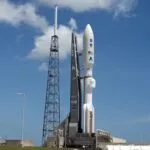
Mission Profile
New Horizons was a Atlas V 551 mission operated by United Launch Alliance that lifted off from Space Launch Complex 41, Cape Canaveral SFS, FL, USA on January 19, 2006. The flight carried its payload on a robotic exploration mission to Solar Escape Trajectory. The launch was a success.