

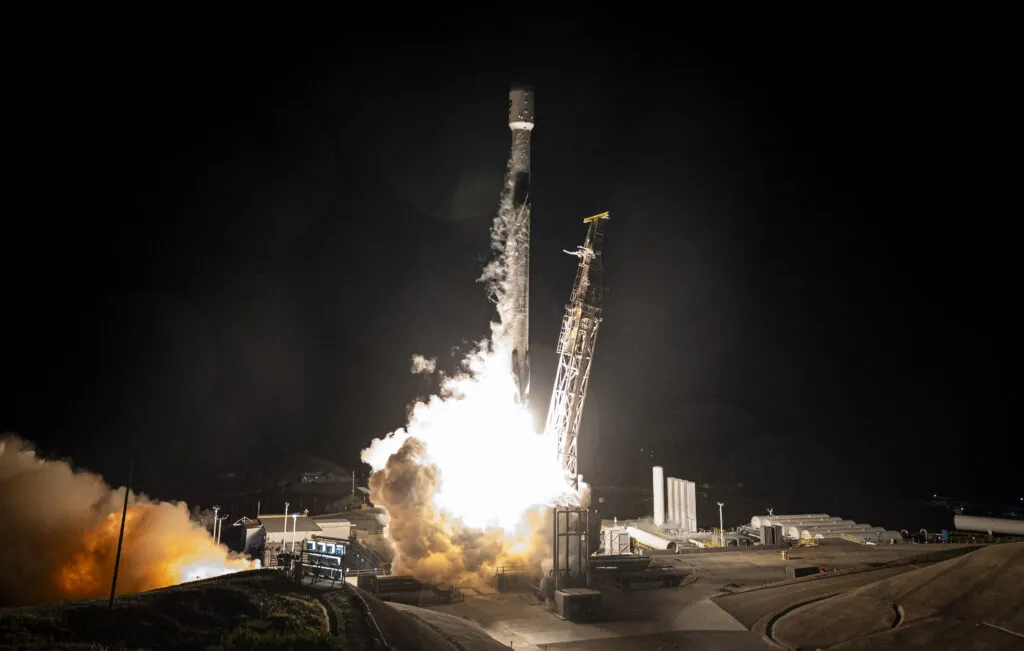
Falcon 9 Block 5 | SPHEREx & PUNCH
SPHEREx is a planned two-year astrophysics mission to survey the sky in the near-infrared light, which, though not visible to the human eye, serves as a powerful tool for answering cosmic questions involving the birth of the universe, and the subsequent development of galaxies.
It also will search for water and organic molecules – essentials for life as we know it – in regions where stars are born from gas and dust, known as stellar nurseries, as well as disks around stars where new planets could be forming. Astronomers will use the mission to gather data on more than 300 million galaxies, as well as more than 100 million stars in our own Milky Way galaxy.
NASA’s Polarimeter to Unify the Corona and Heliosphere (PUNCH) mission will share a ride to space with SPHEREx. It consists of four suitcase-sized satellites, which will focus on the Sun’s outer atmosphere (the corona) and how it generates the solar wind. The spacecraft also will track coronal mass ejections – large eruptions of solar material that can drive large space weather events near Earth – to better understand their evolution and develop new techniques for predicting such eruptions.
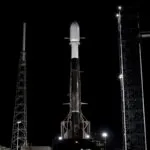
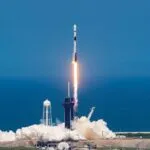
Falcon 9 is a two-stage rocket designed and manufactured by SpaceX for the reliable and safe transport of satellites and the Dragon spacecraft into orbit. The Block 5 variant is the fifth major interval aimed at improving upon the ability for rapid reusability.
When is the Falcon 9 Block 5 | SPHEREx & PUNCH launch?
What rocket is being used for SPHEREx & PUNCH?
Where is the Falcon 9 Block 5 | SPHEREx & PUNCH launching from?
What orbit is SPHEREx & PUNCH going to?
Who is launching SPHEREx & PUNCH?
Can I watch the Falcon 9 Block 5 | SPHEREx & PUNCH launch live?

Mission Profile
SPHEREx & PUNCH was a Falcon 9 Block 5 mission operated by SpaceX that lifted off from Space Launch Complex 4E, Vandenberg SFB, CA, USA on March 12, 2025. The flight carried its payload on a astrophysics mission to Sun-Synchronous Orbit. The first stage, booster B1088, made its 3rd flight, returning to service just 56 days after its previous mission. The launch was a success.