Inconel X-750 is a superalloy used in aerospace applications. Melting point: 1,393 °C. Tensile strength: 1,138 MPa.
Inside a rocket engine, one thin metal wall holds back fuel as cold as deep space on one side and flames of several thousand degrees on the other. Inconel X-750 is one of the alloys tough enough to live in that crossfire.
Quick facts
- Names: Inconel X-750, also called UNS N07750 (a standard identification code) — a trademarked member of the Inconel alloy family. It was originally sold simply as “Inconel X.”
- Type: a precipitation-hardenable nickel-chromium superalloy. “Superalloy” means a metal built to stay strong at very high temperatures; “precipitation-hardenable” means heat treatment can grow tiny strengthening particles inside it.
- Main ingredients: at least 70% nickel, 14-17% chromium, 5-9% iron, 2.25-2.70% titanium, plus small amounts of aluminum, niobium, manganese, silicon, carbon, and copper.
- Density: about 8,300 kg/m3 (0.300 lb per cubic inch).
- Melting range: roughly 1,393-1,427°C (2,540-2,600°F).
- Strength: tensile strength (how hard you can pull before it breaks) of roughly 1,100-1,420 MPa (about 160,000-206,000 psi), depending on heat treatment.
- Temperature range: stays useful from cryogenic (extreme) cold up to about 816°C (1,500°F) under load, and resists surface scaling up to about 980°C (1,800°F).
What it is and how it works
A plain nickel-chromium alloy resists rust and oxidation (the chemical attack that happens when hot metal reacts with oxygen in the air), but on its own it is not especially strong. Inconel X-750 fixes that by adding small amounts of aluminum and titanium.
When the metal is given a carefully controlled heat treatment called aging, those two elements form microscopic particles, known as gamma-prime, scattered all through the metal. Picture sand mixed into wet concrete: the grains lock everything in place so it cannot shift. In the alloy, these particles block the internal sliding that would normally let metal stretch or deform. The result is high strength and strong resistance to creep — the slow stretching that metals suffer under steady load and heat.
Meanwhile, the chromium forms a tough oxide skin on the surface that shields the metal from oxidation and corrosion when hot. And because the nickel base stays ductile (bendable rather than brittle) even when very cold, the same alloy holds up at cryogenic temperatures too. That lets it survive the violent, second-by-second temperature swings inside a firing engine.
Why it matters
A rocket engine demands two opposite things at once: cryogenic propellants chilling one side of a wall while combustion gases of several thousand degrees blast the other, with sharp swings during the burn. Inconel X-750’s mix of high strength for its weight, creep resistance, oxidation resistance, and toughness across that whole temperature range lets engineers build thin-walled, lightweight, regeneratively cooled thrust chambers and nozzles (where propellant flows through the walls to carry heat away). Its high strength means the walls can be thinner, cutting weight where every gram counts on a launch vehicle.
Beyond rockets, the same qualities make it valuable for gas-turbine and jet-engine parts, high-temperature springs and bolts, nuclear reactor components, and pressure vessels.
Notable examples
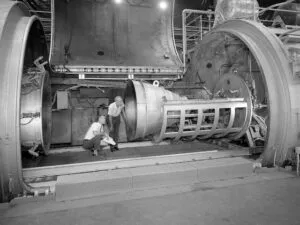
- Rocketdyne F-1 engine (Saturn V, Apollo): the thrust-chamber tube bundle, reinforcing bands, and manifold were Inconel X-750. The chamber wall was built from 178 main tubes (which split into a larger number of smaller tubes farther down the nozzle), with fuel flowing through them to carry heat away — regenerative cooling. The alloy’s strength-to-weight ratio allowed thin-wall tubing while withstanding thrust nearly ten times that of any earlier engine and exhaust gas near 5,800°F (3,200°C).
- North American X-15: the skin of this rocket-powered research aircraft was built from Inconel X (the same alloy) to survive aerodynamic heating at hypersonic speeds.
- Thrust chambers and heat exchangers generally: widely used for its high-temperature strength and oxidation resistance.
- Gas turbines, jet engines, and fasteners: turbine parts plus high-temperature springs and bolts that rely on its resistance to loosening under heat.
Trade-offs to know
The alloy is a derivative of the older Inconel 600 (introduced in 1940), modified with aluminum and titanium to make it age-hardenable. Its peak strength depends on the right heat treatment, and much of that benefit fades above about 1,300°F (700°C), so beyond that point it is used more for oxidation resistance than full structural strength. Different aging recipes trade strength against ductility, giving the same alloy a wide property range. Like most superalloys, it is hard and costly to machine, so it is chosen only where extreme-temperature performance is truly essential.
Ni 70% min, Cr 14-17%, Fe 5-9%, Ti 2.25-2.75%, Al 0.4-1.0%, Nb 0.7-1.2%
| DENSITY | 8 kg/m³ |
| TENSILE STRENGTH | 1,138 MPa |
| YIELD STRENGTH | 758 MPa |
| STRENGTH-TO-WEIGHT | 137439.6 kN·m/kg |
| MELTING POINT | 1,393 °C |
| MAX SERVICE TEMPERATURE | 700 °C |
| THERMAL CONDUCTIVITY | 12.0 W/m·K |
| THERMAL EXPANSION | 12.6 µm/m·K |
| CATEGORY | Superalloy |
| DESIGNATIONS | UNS N07750, AMS 5667, AMS 5670 |
| MANUFACTURER | Special Metals Corporation |
| DENSITY | 8 kg/m³ |
| TENSILE STRENGTH | 1,138 MPa |
| YIELD STRENGTH | 758 MPa |
| MELTING POINT | 1,393 °C |
| MAX SERVICE TEMP | 700 °C |
| THERMAL CONDUCTIVITY | 12.0 W/m·K |
| THERMAL EXPANSION | 12.6 µm/m·K |
| CORROSION RESISTANCE | Excellent |
| WELDABILITY | Fair |
| MACHINABILITY | Moderate |
| COST RATING | High |