Nomex is a aramid fiber used in aerospace applications. Tensile strength: 600 MPa.
Nomex is a tough synthetic fabric that refuses to catch fire the way ordinary cloth does. In spaceflight it shows up everywhere from astronaut clothing to the lightweight panels inside satellites.
Quick facts
- What it is: a heat- and flame-resistant synthetic fiber called a meta-aramid (a family of strong, ring-shaped plastic molecules).
- Made by: DuPont, developed in the early 1960s and first sold in 1967.
- Close relative: Kevlar, the bullet-resistant fiber; Kevlar is a para-aramid, and the two are often blended together.
- Heat limit: withstands short bursts up to about 370 C (700 F). Honeycomb forms work long-term around 180-220 C.
- Strength: the fiber has an ultimate tensile strength (the pull it can take before snapping) of about 340 MPa (49,000 psi).
- Key trait: it does not melt or drip; instead it chars and thickens.
What it is and how it works
Nomex is built from rigid chains of benzene rings (six-carbon loops that are unusually stable when heated). This backbone is what makes it special. When ordinary nylon meets a flame, it melts and drips, and can stick to skin. Nomex does the opposite: the heat turns its surface into a charred, thickened crust. Think of how a marshmallow blackens and forms a tough shell rather than vanishing. That carbonized layer acts as insulation, slowing the spread of flame and blocking heat from passing through.
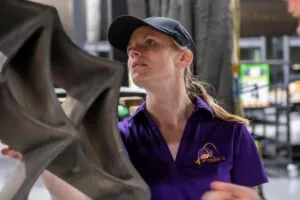
Because of this, Nomex appears in spaceflight in three main forms. As spun fiber and fabric, it becomes protective clothing and spacesuit cover layers that will not ignite or stick to the wearer. As paper or felt, it serves as electrical insulation and flexible thermal blankets. And as honeycomb core, sheets of resin-soaked Nomex paper are expanded into a hexagonal cell pattern (like a beehive) and bonded between thin composite face sheets. This sandwich is extremely stiff for its weight, giving engineers strong, light panels.
Why it matters
Nomex earns its place in space for two reasons: fire safety and saving weight. The fire lesson came at a terrible cost. In 1967 the Apollo 1 cabin fire, fed by a pure-oxygen atmosphere, killed three astronauts. NASA responded by stripping flammable materials out of its hardware, and Nomex became a fire- and abrasion-resistant cover layer in the Apollo suits. One important caveat remained: Nomex is fire-resistant, not fireproof in pure oxygen, so the outermost suit layer used Beta cloth (Teflon-coated fiberglass) instead.
The second reason is mass. Every kilogram sent to orbit is expensive, so the high stiffness-to-weight of Nomex honeycomb makes it a workhorse for satellite and spacecraft panels and launch-vehicle structures. Its flame resistance also makes it the standard for astronaut and ground-crew clothing.
Where it is used
On the Space Shuttle, heat-treated Nomex felt formed the Felt Reusable Surface Insulation (FRSI). These silicone-coated blankets covered roughly half of the orbiter’s cooler upper surfaces, including the payload bay doors, fuselage sides, and upper wings, wherever reentry stayed below about 370 C. NASA lists this material at a density near 86.5 kg/m3 and a single-use limit around 371 C. It saved weight compared with ceramic tiles, which were reserved for the hotter zones.
Nomex also flew on the Apollo spacesuits, and it appears in modern gear including the Extravehicular Mobility Unit (the spacewalking suit) and the Advanced Crew Escape Suit worn by Shuttle crews, often alongside Kevlar and Gore-Tex. Beyond suits, Nomex reached other worlds: it was used in the airbag landing systems of Mars Pathfinder and the Mars Exploration Rovers (the load-bearing bags themselves were woven mainly from Vectran), and as external covering on the Galileo Jupiter probe and the Cassini-Huygens Titan probe. And inside countless satellites, resin-impregnated Nomex honeycomb quietly forms the lightweight panels that hold everything together.
Poly-metaphenylene isophthalamide (PMIA)
| DENSITY | 1 kg/m³ |
| TENSILE STRENGTH | 600 MPa |
| STRENGTH-TO-WEIGHT | 434782.6 kN·m/kg |
| MAX SERVICE TEMPERATURE | 300 °C |
| THERMAL CONDUCTIVITY | 0.13 W/m·K |
| CATEGORY | Aramid Fiber |
| DESIGNATIONS | Nomex T410, Nomex T412, HRH-10 |
| MANUFACTURER | DuPont / Hexcel |
| DENSITY | 1 kg/m³ |
| TENSILE STRENGTH | 600 MPa |
| MAX SERVICE TEMP | 300 °C |
| THERMAL CONDUCTIVITY | 0.13 W/m·K |
| CORROSION RESISTANCE | Excellent |
| WELDABILITY | N/A |
| MACHINABILITY | Specialized |
| COST RATING | Moderate |