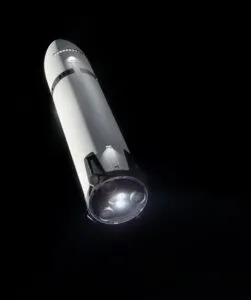
Liquid Methane (CH4) (CH₄) is a cryogenic fuel propellant used as a fuel. Cryogenic but warmer than LH2, easier to handle. Typical ISP: 330–380 s (with LOX) seconds.
Liquid methane is the rocket fuel behind a new wave of reusable spacecraft. It is the simplest hydrocarbon, the main ingredient in natural gas, and chilled cold enough it turns into a dense liquid that engines can pump and burn.
Quick facts
- Chemical formula: CH4 — one carbon atom bonded to four hydrogen atoms, the simplest hydrocarbon (a molecule made only of hydrogen and carbon) and the primary component of natural gas/LNG.
- State in rockets: a cryogenic liquid (a gas chilled until it becomes liquid). Its boiling point is about -161 to -162 C (-258 F) at normal air pressure.
- Why liquefy it: turning the gas into a liquid shrinks it to roughly 1/600th of its volume, so far more fuel fits in a tank.
- Usual partner: liquid oxygen (LOX), stored near -183 C. The LOX/methane pairing is nicknamed “methalox.”
- Mixture ratio: roughly 3.6 parts oxygen to 1 part methane by mass (about 78% oxygen, 22% methane in SpaceX’s Raptor engine).
- World first: on 12 July 2023, LandSpace’s Zhuque-2 became the first methane-fueled rocket to reach orbit.
What it is and how it works
In a methalox engine, methane is the fuel and liquid oxygen is the oxidizer (the substance that supplies oxygen so the fuel can burn — there is no air in space to do that job). Both are stored as deeply chilled cryogenic liquids, often “subcooled” below their boiling points so more mass packs into each tank and the pumps work better.
Powerful turbopumps force the two liquids into a combustion chamber, where they ignite. The hot, fast-moving exhaust — mostly water vapor (H2O) and carbon dioxide (CO2) — is squeezed through a nozzle to produce thrust, the push that lifts the rocket.
Methane’s biggest advantage shows up over many flights. Because it is a small, simple molecule, it burns very cleanly and leaves almost no carbon soot. Soot buildup, called “coking,” clogs the cooling channels, pumps, and injectors of dirtier fuels. Think of methane as a clean-burning gas flame that leaves the pan spotless, versus a sooty candle that blackens everything it touches. The most advanced methalox engines use a full-flow staged combustion cycle (Raptor) or oxygen-rich staged combustion (BE-4) to run both propellants through the turbines without wasting any fuel, reaching very high chamber pressures — Raptor 2 around 300 bar, Raptor 3 about 330 bar.
Why it matters
Methane sits in a performance “sweet spot” between the two older choices. Specific impulse — a measure of how efficiently an engine turns fuel into thrust, given in seconds — is higher for methalox than for kerosene. Methalox reaches roughly 327-350 seconds at sea level and around 380 seconds in vacuum-tuned engines, while refined kerosene (RP-1) with LOX tops out around 311-340 seconds. Hydrogen with LOX scores even higher, about 450-plus seconds, but hydrogen is bulky, leaks easily, and makes metal brittle. Methane is denser than liquid hydrogen, does not cause that hydrogen embrittlement, and has a much higher boiling point, so its tanks are smaller and lighter and its fuel is far easier to store and handle.
That clean, soot-free burn is the key to rapid reuse. With little soot to scrub away, a methane engine can in principle be inspected, refueled, and flown again in hours rather than the weeks of refurbishment that dirtier fuels demand — the kind of fast turnaround that drives launch costs down, and a core design goal of engines like Raptor. There is one more reason methane is called the propellant of the future. Methane and oxygen can, in principle, be made on Mars from the planet’s atmospheric CO2 and water ice using the Sabatier reaction — a process called in-situ resource utilization. A spacecraft could refuel for the trip home rather than carrying all its propellant from Earth.
Where it is used and notable examples
- SpaceX Raptor / Starship: Raptor uses a full-flow staged combustion cycle. Super Heavy uses 33 Raptors and Starship 6. Raptor 2 runs about 300 bar and roughly 230 tonnes-force of sea-level thrust; Raptor 3 about 330 bar and roughly 250 tonnes-force.
- Blue Origin BE-4: a methalox engine using oxygen-rich staged combustion — the first such engine built in the U.S. It powers ULA’s Vulcan Centaur and Blue Origin’s New Glenn (seven BE-4s per New Glenn first stage).
- LandSpace Zhuque-2 (China): first methane-fueled rocket ever to reach orbit, on 12 July 2023. Its first stage uses four TQ-12 methalox engines (about 67 tonnes-force each), reaching a roughly 431-by-461 km Sun-synchronous orbit.
- ULA Vulcan Centaur: its booster runs on two BE-4 methalox engines, replacing the Russian RD-180 kerosene engines used on the Atlas V.
- In development: Rocket Lab’s Neutron (Archimedes engine) and Relativity Space’s Terran R (Aeon engine), reflecting an industry-wide shift toward methane.
Studied since the 1960s but only reached flight hardware in the 2020s with SpaceX Raptor and Blue Origin BE-4.
Good Isp, better density than LH2, clean combustion (no coking), ISRU potential on Mars, self-pressurizing
Lower Isp than hydrogen, cryogenic handling required, lower density than RP-1