


About Callisto
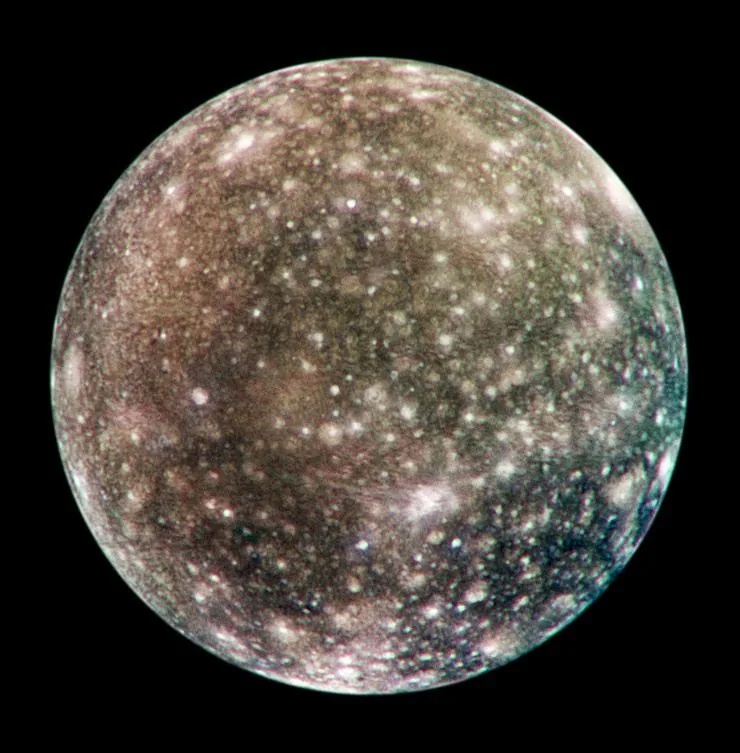
Callisto is the outermost of the four Galilean moons, the second-largest moon of Jupiter, and the third-largest in the Solar System. Its surface is the most heavily cratered of any known body — essentially at the saturation limit, where each new crater destroys an older one — indicating that Callisto has experienced very little geological resurfacing in 4 billion years.
Because it orbits outside the Laplace resonance that drives the intense tidal heating of Io, Europa and Ganymede, Callisto has stayed geologically cold. It is also only partially differentiated: a rocky core, icy-rocky mantle, and icy crust, without the sharp iron/mantle/crust separation of its siblings. Magnetometer data from the Galileo orbiter nevertheless suggest the presence of a ~100-200 km deep salty subsurface ocean.
Because Callisto orbits well outside Jupiter’s most intense radiation belts, it is the Jovian moon on which a future human outpost would be most feasible. ESA’s JUICE mission will make 21 flybys of Callisto in 2031-2034.
Physical Properties
Atmosphere Composition
- Carbon Dioxide very thin
- Molecular Oxygen possibly detected
Orbit
Missions to Callisto
2 spacecraft tracked on Space Launch Live.
Gallery
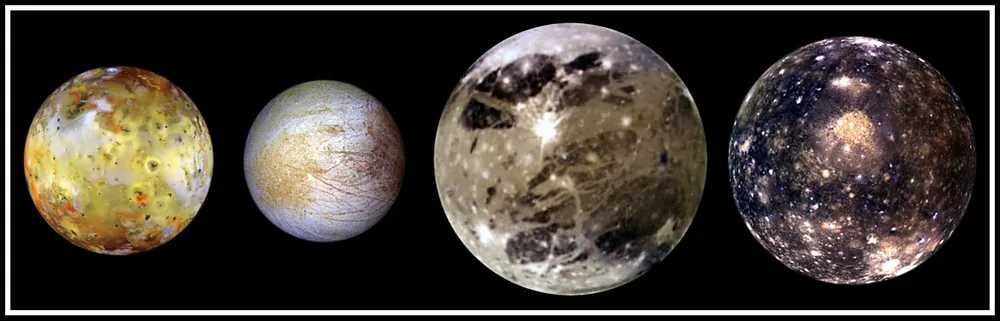
Hand-picked mission imagery of Callisto sourced from NASA and partner archives. Click any photo for full resolution and source attribution.
Imagery on this page is provided by the original mission teams. Full attribution terms: Image Rights & Credits.
Sources & Further Reading
- NASA — official mission / factsheet page
- Wikipedia — extensive cross-referenced article
- NASA u2014 Callisto
- ESA JUICE Mission
Numerical values (radius, mass, orbital elements, temperatures) are drawn from NASA NSSDC Planetary Fact Sheets, JPL Horizons, and the JPL Small-Body Database. Last refreshed: 2026-06-08 01:37:01.