

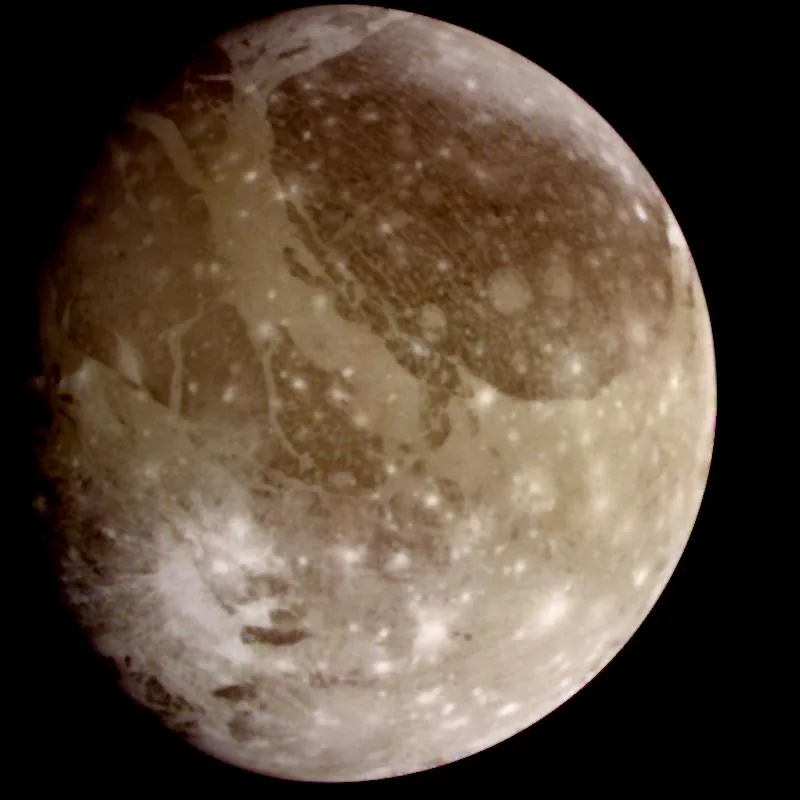
About Ganymede
Ganymede is the largest and most massive moon in the Solar System — larger in diameter than Mercury (though only ~45% of its mass). It is the only moon known to generate its own intrinsic magnetic field, created by circulation in its liquid iron core. This small magnetosphere is nested inside Jupiter’s much larger one, producing auroral phenomena that helped Hubble confirm the existence of Ganymede’s subsurface ocean in 2015 by measuring the way Ganymede’s auroral belts rock in response to Jupiter’s shifting field.
Ganymede is fully differentiated, with an iron-rich core, silicate mantle, a layer of ice that includes high-pressure ice phases, and a liquid water ocean estimated at 100 km thick sitting ~150 km below the icy surface.
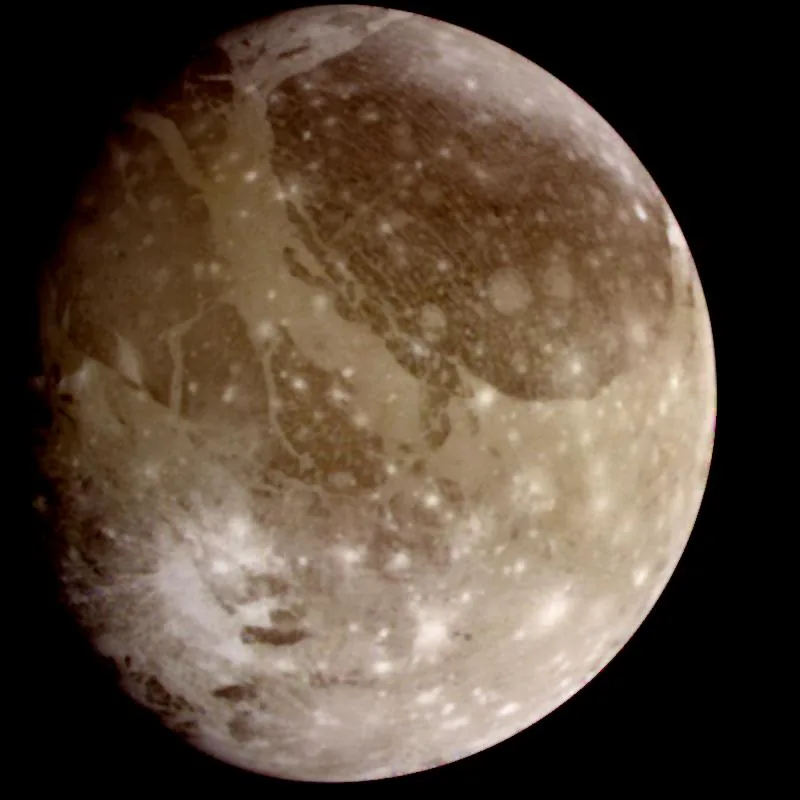
Its surface shows two major terrain types: dark, heavily cratered regions roughly 4 billion years old, and bright, younger grooved terrain cut by extensive tectonic features. The European Space Agency’s JUICE (Jupiter Icy Moons Explorer) mission — launched 14 April 2023 — will arrive at Jupiter in July 2031 and in 2034 will become the first spacecraft ever to orbit a moon other than Earth’s when it enters orbit around Ganymede.
Physical Properties
Atmosphere Composition
- Oxygen (Ou2082) exosphere very thin, from photolysis of water ice
- Hydrogen, Ozone detected
Orbit
Missions to Ganymede
3 spacecraft tracked on Space Launch Live.
Gallery
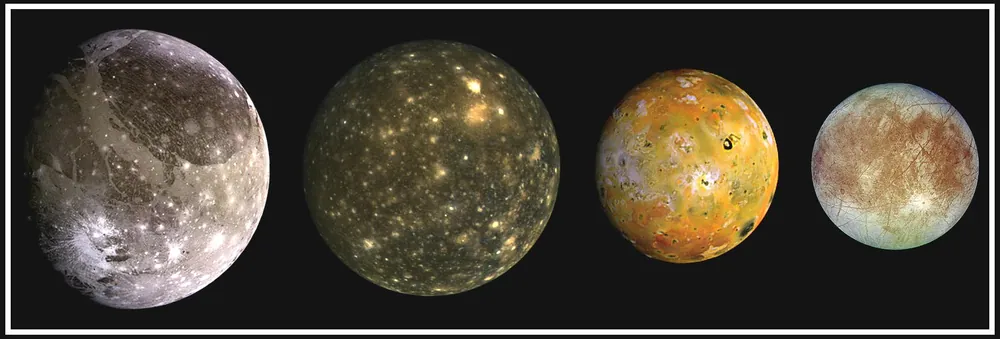
Hand-picked mission imagery of Ganymede sourced from NASA and partner archives. Click any photo for full resolution and source attribution.
Imagery on this page is provided by the original mission teams. Full attribution terms: Image Rights & Credits.
Sources & Further Reading
- NASA — official mission / factsheet page
- Wikipedia — extensive cross-referenced article
- NASA u2014 Ganymede
- ESA JUICE Mission
Numerical values (radius, mass, orbital elements, temperatures) are drawn from NASA NSSDC Planetary Fact Sheets, JPL Horizons, and the JPL Small-Body Database. Last refreshed: 2026-06-08 01:37:01.