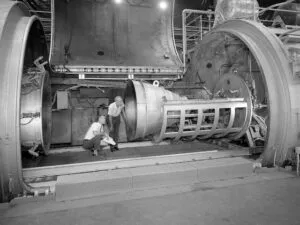
The Merlin 1D Vacuum is the rocket engine that finishes the job: after a Falcon 9 climbs out of the thick lower air, this single engine takes over and drives the upper part of the rocket the rest of the way to orbit. It is built for the emptiness of space, where it can shut off and light again to drop payloads exactly where they belong.
Quick facts
- Maker: SpaceX. Also called Merlin Vacuum or MVac.
- Job: the single engine on the upper (second) stage of the Falcon 9 and Falcon Heavy rockets. The first stage below it uses nine sea-level Merlin 1D engines.
- Fuel: liquid oxygen (LOX, the oxidizer that lets the fuel burn) plus RP-1, a refined kerosene similar to jet fuel.
- Power cycle: gas-generator, also called an open cycle.
- Thrust in vacuum: about 981 kilonewtons (220,500 pounds of force) as of 2020. Earlier versions were lower.
- Specific impulse (Isp): about 348 seconds — the highest of any U.S. kerosene engine in its class. Isp is a measure of fuel efficiency: how much push you get from each bit of propellant.
- Nozzle: a large bell with a 165:1 expansion ratio, made of niobium alloy.
- Throttle: can dial down to about 39 percent of full thrust.
- Restarts: designed to re-ignite multiple times in flight (around ten).
What it is and how it works
The Merlin 1D Vacuum is a pump-fed liquid-propellant engine, meaning pumps push the chilled LOX and RP-1 into the engine rather than relying on tank pressure alone. It runs on a gas-generator cycle: a small portion of the propellant is burned to spin a turbopump (a turbine-driven pump), which then forces the main propellants into the combustion chamber at high pressure. The exhaust from that small burner is simply dumped overboard.
To light the engine, SpaceX injects TEA-TEB, a chemical mixture that bursts into flame the instant it touches oxygen (this is called pyrophoric). There is no spark plug or pilot flame, and because the igniter fluid can be injected again, the engine can relight out in space.
The feature that sets the MVac apart from its sea-level sibling is the nozzle. In space there is no surrounding air pushing back, so the engine can use a much larger bell that lets the exhaust expand further before it leaves — squeezing more push and efficiency out of the same propellant. Think of it like a wider trumpet bell that captures more of the sound. That big niobium nozzle extension is radiatively cooled: it glows red-hot and sheds heat by giving off light, rather than being cooled by circulating propellant. The combustion chamber, by contrast, is regeneratively cooled, with propellant flowing around it to carry heat away.
Why it matters
The Merlin Vacuum is the workhorse upper-stage engine behind the world’s most-flown orbital rocket family. Its ability to throttle, shut down, coast, and restart lets a single, relatively simple kerosene engine deliver payloads to a wide range of destinations — low Earth orbit, geostationary transfer orbit, and beyond. That versatility is part of what makes Falcon 9 so flexible, and it fits the rocket’s reusable design: the nine first-stage Merlins land back on Earth while the upper-stage MVac completes the mission.
The engine also holds a notable distinction: the highest specific impulse of any U.S. hydrocarbon engine in its class. That shows a low-cost LOX/kerosene engine can rival more exotic fuel choices for upper-stage work. The open-cycle design is a deliberate trade — dumping the turbine exhaust overboard is less efficient than burning it, but it keeps the engine simpler, cheaper, and reliable.
Where it is used
- Falcon 9 v1.1 — the first vehicle to fly the Merlin 1D Vacuum, introduced in 2013, with one MVac per upper stage.
- Falcon 9 Full Thrust / Block 5 — today’s Falcon 9, with a single uprated MVac powering the upper stage.
- Falcon Heavy — the same single Merlin Vacuum sits atop its three-core configuration.
- Multi-burn missions — a long burn to a parking orbit, a coast of several minutes, then an MVac restart to push a satellite into geostationary transfer orbit.
- Dragon, Starlink, and satellite launches — crew and cargo flights to the ISS plus commercial and government missions all rely on the MVac for the final orbital-insertion burn.
| Thrust (Sea Level) | N/A (vacuum only) kN |
| Thrust (Vacuum) | 981 kN (220,500 lbf) kN |
| ISP (Sea Level) | N/A s |
| ISP (Vacuum) | 348 s s |
| Chamber Pressure | 9.7 MPa (1,410 psi) bar |
| Mass | 490 kg |
| Thrust-to-Weight | 204 |
| Throttle Range | 60–100% |
| Restart Capable | Yes (multiple) |
| Kilonewtons | 981.0 kN |
| Pounds-force | 220,538 lbf |
| Propellant | RP-1 |
| Oxidizer | LOX |
| Engine Cycle | Gas Generator |
| Mixture Ratio | 2.36:1 |
| Flow Rate | ~280 kg/s kg/s |
| Dimensions | 0.92 m diameter × 3.5 m length (with nozzle extension) |
| Combustion Chambers | 1 |
| Nozzle Expansion Ratio | 165:1:1 |
| Manufacturer | SpaceX |
| Country | United States |
| Status | Active |
| First Flight | September 13, 2026 |
- Merlin 1D Vacuum
- Merlin 1D Vacuum+
- Falcon 9 (second stage)
- Falcon Heavy (second stage)