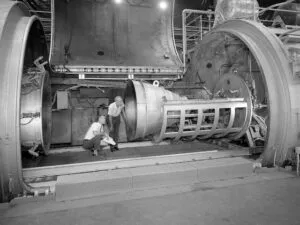
The NK-33 is a Soviet rocket engine with an almost unbelievable backstory: it was built for a secret Moon rocket that never succeeded, sat forgotten in warehouses for about 20 years, and then flew to orbit decades later on American and Russian launchers.
Quick facts
- Designer: Kuznetsov Design Bureau (OKB-276), USSR
- Developed: 1968-1972
- Propellants: liquid oxygen (LOX) and RP-1 kerosene (a refined rocket fuel similar to jet fuel)
- Cycle: oxidizer-rich staged combustion (closed cycle)
- Sea-level thrust: ~1,510 kN (about 340,000 pounds of force)
- Vacuum thrust: ~1,638-1,680 kN (about 368,000-380,000 pounds of force)
- Specific impulse: 297 s at sea level, 331 s in vacuum (a measure of fuel efficiency)
- Dry mass: ~1,222-1,240 kg
- Thrust-to-weight ratio: ~137:1 (among the highest of any launch engine ever)
- Size: ~3.7 m long, ~1.49 m wide
- GRAU index: 14D15 (refurbished version: NK-33A)
What it is and how it works
An engine’s job is to push hot gas out the back very fast so the rocket goes the other way. The NK-33 does this by burning kerosene with liquid oxygen in a single combustion chamber (the part where fuel and oxidizer ignite). To feed those propellants in fast enough, it uses turbopumps (spinning pumps driven by a small gas turbine).
The clever part is how it powers that turbine. The NK-33 uses an oxidizer-rich staged-combustion cycle. A small “preburner” burns the propellants with extra oxygen to spin the turbine, and then the hot, oxygen-rich gas is routed into the main chamber instead of being dumped overboard. Think of it like a kitchen that reuses the heat from one burner to finish cooking elsewhere, wasting nothing. Because no partly burned propellant is thrown away, the engine reaches very high efficiency and a high chamber pressure of 14.83 MPa (about 2,151 psi).
Running the preburner oxygen-rich (rather than fuel-rich, as most American engines of the era did) avoids soot buildup but blasts the turbine with extremely hot oxygen, which is fiercely corrosive. Soviet engineers solved this with specialized metal alloys—an approach the West had long considered impractical. The engine can throttle between about 50% and 105% of power, and in Aerojet’s version a gimbal mechanism let it swivel for steering.
Why it matters
Technically, the NK-33 proved that high-performance kerosene engines were possible. Its oxygen-rich staged-combustion design and class-leading thrust-to-weight ratio shaped the family of Soviet and Russian engines that followed, including the RD-170, the RD-180 (used for years on America’s Atlas V rocket), and the RD-191/RD-193. When samples reached the West in the 1990s, they astonished US engineers and changed Western thinking about what such engines could achieve.
Historically, the engine is a relic of the Soviet Union’s secret Moon program. Roughly 60 to 80 finished engines were stockpiled after the program ended, and about 36 were sold to the American company Aerojet in the mid-1990s for around $1.1 million each—giving 1970s hardware a remarkable second life.
Where it is used
- N1 / N1F Moon rocket (Soviet): the NK-33 and its vacuum-optimized sibling, the NK-43 (which had a larger nozzle for use higher up), were designed for the upgraded N1F first stage. The program was cancelled in 1974 before these improved engines ever flew.
- Aerojet AJ-26: refurbished, “Americanized” NK-33 engines fitted with a gimbal and US electronics.
- Orbital Sciences Antares: used two AJ-26 engines on its first stage, with a first successful flight on April 21, 2013. After an Antares engine failed seconds after liftoff on October 28, 2014—destroying the rocket and its Cygnus cargo—Orbital switched to the NPO Energomash RD-181 (announced December 17, 2014).
- Soyuz-2.1v (Russian light launcher): uses the refurbished NK-33A. It was hot-fire tested on January 15, 2013, and first flew on December 28, 2013. Russia’s stock was reportedly being exhausted by around 2025, with the RD-193 planned as a replacement.
The catch
The same oxidizer-rich design that makes the NK-33 so efficient also makes it metallurgically demanding, and mastering that corrosive hot-oxygen environment was a major achievement. The bigger limitation today is supply: the engine is no longer in production, so use has always been capped by the finite 1970s stockpile—a key reason Antares eventually abandoned it. The 2014 in-flight loss, preceded by test-stand anomalies, raised fair questions about relying on decades-old refurbished hardware, even though the underlying design was widely regarded as sound and ahead of its time.
| Thrust (Sea Level) | 1,510 kN (339,000 lbf) kN |
| Thrust (Vacuum) | 1,680 kN (378,000 lbf) kN |
| ISP (Sea Level) | 297 s s |
| ISP (Vacuum) | 331 s s |
| Chamber Pressure | 14.5 MPa (2,100 psi) bar |
| Mass | 1 kg |
| Thrust-to-Weight | 137 |
| Throttle Range | Not throttleable |
| Restart Capable | No |
| Kilonewtons | 1.0 kN |
| Pounds-force | 225 lbf |
| Propellant | RP-1 |
| Oxidizer | LOX |
| Engine Cycle | Oxygen-Rich Staged Combustion |
| Mixture Ratio | 2.8:1 |
| Flow Rate | ~518 kg/s kg/s |
| Dimensions | 1.45 m diameter × 3.7 m length |
| Combustion Chambers | 1 |
| Nozzle Expansion Ratio | 26.8:1:1 |
| Manufacturer | SNTK Kuznetsov |
| Country | Russia / USSR |
| Status | Retired |
| First Flight | January 1, 1970 |
- NK-33
- NK-33-1
- AJ-26 (Aerojet adaptation)
- N1 (Block A)
- Soyuz 2.1v
- Antares 100 series