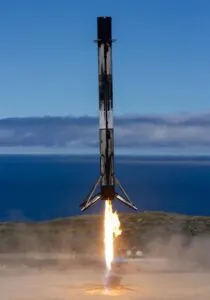
The Commercial Crew Program (CCP) is NASA’s way of buying rides to space instead of building its own spaceships. It pays American companies to carry NASA astronauts to and from the International Space Station (ISS) — the crewed laboratory that orbits Earth.
Quick facts
- Started: 2011, as NASA shifted from building crew vehicles in-house to buying flights from companies.
- Final contracts awarded: September 16, 2014 — SpaceX received $2.6 billion to finish and certify its Crew Dragon, and Boeing received $4.2 billion for its CST-100 Starliner (about $6.8 billion total).
- First crewed flight: SpaceX Demo-2 launched May 30, 2020, at 3:22 p.m. EDT from Launch Complex 39A at Kennedy Space Center, carrying astronauts Bob Behnken and Doug Hurley.
- First operational mission: SpaceX Crew-1, November 16, 2020.
- Reported NASA seat prices: roughly $55 million on Crew Dragon and about $90 million on Starliner.
What it is and how it works
CCP is a public-private partnership — a deal in which the government and private businesses each do part of the work. Instead of the older approach where NASA designed, owned, and operated its own spacecraft (as with Mercury, Gemini, Apollo, and the Space Shuttle), each company designs its own spacecraft, its own rocket, and its own way of running missions. The companies build, own, and operate the hardware. NASA sets the high-level safety and performance rules, acts as an expert customer, and buys transportation as a service.
A useful comparison: rather than owning a fleet of cars and hiring its own drivers, NASA buys seats from competing ride providers and checks that those rides are safe. The contracts are fixed-price, meaning the price is agreed up front rather than NASA paying whatever the bill turns out to be.
Before any company can carry NASA crews, it must pass a certification campaign — a series of required tests. This includes an abort test (proving the capsule can pull its crew to safety in an emergency), an uncrewed orbital flight that autonomously docks with the ISS (connects to the station on its own, with no human steering), and a crewed flight test. Only then does NASA grant human-rating certification, its formal approval to fly people on regular rotation missions. Because the companies keep ownership of their vehicles, they can also sell the same spacecraft to private customers, spreading the costs beyond NASA.
Why it matters
When the Space Shuttle retired in 2011, the United States lost its ability to launch astronauts from American soil. For nearly a decade, NASA bought seats on Russia’s Soyuz spacecraft, with prices rising toward roughly $80–90 million per seat. CCP closed that gap: Crew Dragon began flying astronauts in 2020, ending sole reliance on Russia.
The program also gave NASA two competing providers, so that one grounded vehicle does not strand the ISS. By buying crew transport as a fixed-price service, NASA aimed to lower costs and free its engineers to focus on deep-space goals such as the Artemis Moon program and eventual Mars missions. It built on the earlier cargo-delivery program and helped grow a wider commercial economy in low Earth orbit, including private crewed visits to the ISS.
Notable examples
- SpaceX Crew Dragon (Dragon 2): the crew capsule that flies on a Falcon 9 rocket from Kennedy Space Center’s LC-39A; NASA’s operational provider since 2020.
- Boeing CST-100 Starliner: Boeing’s capsule, launched on a United Launch Alliance Atlas V rocket. It flew an uncrewed test (OFT-2, May 2022) and a crewed flight test (June 2024) that docked despite helium leaks and thruster issues; it is still working toward operational certification.
- SpaceX Demo-2 (May 30, 2020): the first crewed CCP flight, carrying Bob Behnken and Doug Hurley. They spent 64 days in space (about 62 aboard the ISS) and splashed down August 2, 2020 — restoring U.S. astronaut launches from American soil for the first time since 2011.
- SpaceX Crew-1 (November 16, 2020): the first operational, full-duration crew-rotation mission, carrying four astronauts to the ISS.
- Boeing Orbital Flight Test (December 2019): Starliner’s first uncrewed demo, which failed to reach the ISS because of a mission-timer software error — a reminder of the risks the certification process is designed to catch.
| 🚀 Demo-2 u2013 First operational Crew Dragon |
| 🚀 Starliner CFT |
| 🚀 Crew-1 through Crew-9 |
| Category | Program |
| Era | Commercial |
| Agency | NASA |
| Country | United States |
| Start Date | 2014-09-16 |
| Total Flights | 15 |
| Success Rate | 100% |
| Successor | Commercial LEO Destinations |
| Original Cost | $8.3 billion (program) |
| Inflation-Adjusted | $8.3 billion (2020) |