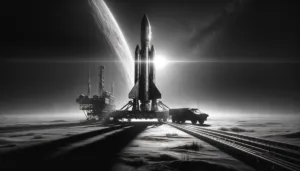
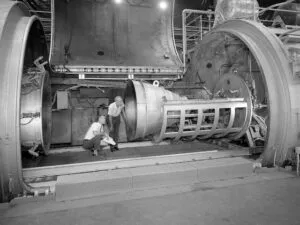
The N1 was the Soviet Union’s giant Moon rocket, its answer to the American Saturn V and its best hope of landing a cosmonaut on the Moon. It was one of the most powerful rockets ever built, yet it never reached orbit. All four of its test launches failed, and the program was quietly cancelled.
Quick facts
- Built by: the Soviet Union, led by the design bureau of Sergei Korolev (and after his death, Vasily Mishin).
- Test launches: four, between 1969 and 1972, all failures.
- First stage engines: thirty NK-15 engines clustered together, a record number that was extremely hard to control.
- Purpose: to send cosmonauts to the Moon in the Space Race.
Why it failed
The N1’s central weakness was its first stage, which used thirty engines firing at once because the Soviets lacked a single huge engine like the American F-1. Coordinating thirty engines, their plumbing, and their vibrations proved nearly impossible with the technology of the time. There was also no money or time to test the full first stage on the ground before flight, so each launch was effectively the first real test. Every attempt ended in failure, including a 1969 explosion on the pad that was one of the largest non-nuclear blasts in history.
Why it mattered
The N1’s failures meant the Soviet Union lost the race to the Moon, and the program was secret for decades; the West did not even confirm its existence for years. Yet its legacy lived on through its engines. The advanced NK-33 engines developed for the N1 were stored away rather than destroyed, and decades later some were refurbished and flown on modern American and Russian rockets, a surprising second life for hardware from a rocket that never succeeded.
| 🚀 All four flights failed |
| 🚀 Second launch caused largest non-nuclear explosion in rocketry |
| Category | Launch Vehicle |
| Era | Space Race |
| Agency | OKB-1 (Mishin) |
| Country | Soviet Union |
| Start Date | 1969-02-21 |
| End Date | 1972-11-23 |
| Total Flights | 4 |
| Successor | Energia |
| Original Cost | ~2.5 billion rubles |
| Inflation-Adjusted | ~$18 billion (2020 est.) |