

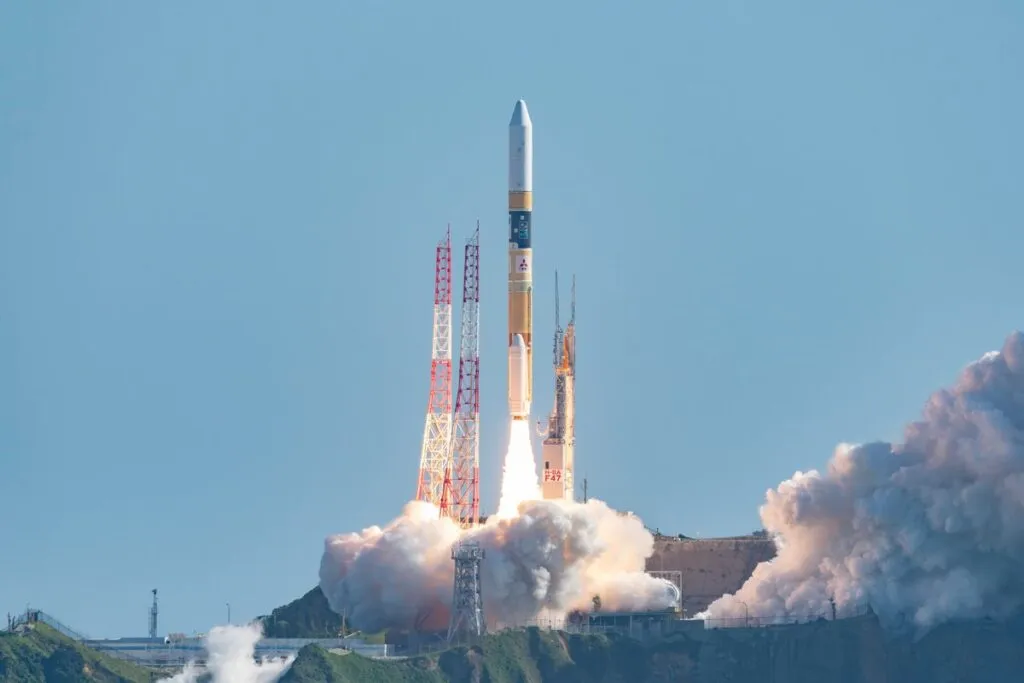
H-IIA 202 | GOSAT-GW (Ibuki GW)
GOSAT-GW (Greenhouse Gases Observing Satellite Greenhouse gases and Water cycle), also known as Ibuki GW and formerly known as GOSAT 3, is JAXA’s next generation satellite to monitor the greenhosue gases like carbon dioxide in the Earth’s atmosphere. It is the follow on to the GOSAT 2 (Ibuki 2) and GCOM-W (Shizuku) missions.
GOSAT-GW will have two missions: greenhouse gases observation for Japan’s Ministry of the Environment and the National Institute for Environmental Studies (NIES), and water-cycle observation for JAXA. By developing the GOSAT-GW satellite, Mitsubishi Electric will contribute to measures for preventing disasters attributed to global warming and climate change, and to advance scientific and technological methods that enable more accurate prediction of climate change.
In December 2013, Mitsubishi Electric (MELCO) was selected as the prime contractor for the spacecraft and the instruments.
H-IIA (H2A) is an active expendable launch system operated by Mitsubishi Heavy Industries (MHI) for the Japan Aerospace Exploration Agency. The liquid-fueled H-IIA rockets have been used to launch satellites into geostationary orbit, to launch a lunar orbiting spacecraft, and to launch Akatsuki, which studied the planet Venus. Launches occur at the Tanegashima Space Center.
When is the H-IIA 202 | GOSAT-GW (Ibuki GW) launch?
What rocket is being used for GOSAT-GW (Ibuki GW)?
Where is the H-IIA 202 | GOSAT-GW (Ibuki GW) launching from?
What orbit is GOSAT-GW (Ibuki GW) going to?
Who is launching GOSAT-GW (Ibuki GW)?
Can I watch the H-IIA 202 | GOSAT-GW (Ibuki GW) launch live?

Mission Profile
GOSAT-GW (Ibuki GW) was a H-IIA 202 mission operated by Japan Aerospace Exploration Agency that lifted off from Yoshinobu Launch Complex LP-1, Tanegashima Space Center, Japan on June 28, 2025. The flight carried its payload on a earth science mission to Sun-Synchronous Orbit. The launch was a success.