


H-IIA 2022 | Daichi
ALOS (Advanced Land Observation Satellite) is used for cartography, regional observation, disaster monitoring, and resource surveying.
ALOS has three remote-sensing instruments:
– the Panchromatic Remote-sensing Instrument for Stereo Mapping (PRISM) for digital elevation mapping with 2.5 meter resolution,
– the Advanced Visible and Near Infrared Radiometer type 2 (AVNIR-2) for precise land coverage observation with 10 meter resolution, and
– the Phased Array type L-band Synthetic Aperture Radar (PALSAR) for day-and-night and all-weather land observation.
ALOS transmitts its data via the DRTS (Kodama) satellite.
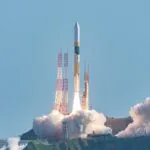
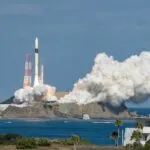
The ALOS was launched by an H-2A-2022 launch vehicle from the Tanegashima Space Center. ALOS as been given the nickname Daichi.
Five minutes after spacecraft separation, ALOS began to unfurl its 72-foot solar array that will provide electrical power to the craft throughout its mission. Six cameras are on-board to visually verify the correct deployment of the solar panel and various instrument antennas.
ALOS lost all power on 22. April 2011, thus ending the mission.
The H-IIA rocket family is an expendable launch system operated by Mitsubishi Heavy Industries for the Japan Aerospace Exploration Agency. The liquid fuelled rocket has been used to launch satellites, lunar spacecraft and planetary science craft.
When is the H-IIA 2022 | Daichi launch?
What rocket is being used for Daichi?
Where is the H-IIA 2022 | Daichi launching from?
What orbit is Daichi going to?
Who is launching Daichi?
Can I watch the H-IIA 2022 | Daichi launch live?

Mission Profile
Daichi was a H-IIA 2022 mission operated by Japan Aerospace Exploration Agency that lifted off from Yoshinobu Launch Complex LP-1, Tanegashima Space Center, Japan on January 24, 2006. The flight carried its payload on a earth science mission to Sun-Synchronous Orbit. The launch was a success.