


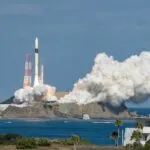
H-IIA 204 | Kiku-8
ETS-VIII (Engineering Test Satellite) is to be launched in 2006, with the main purpose of dealing with the increasing demand for digital communications, such as mobile phones and other mobile devices. The satellite, with a gross weight of around three tons and a diameter of 40 meters, has two Large Deployable Antenna Reflectors (LDAR) and two Solar Array paddles. One LDAR, about the size of a tennis court, is one of the world’s largest geostationary satellites. Its size will enable direct communications with a geostationary satellite that covers all of Japan, making mobile communications more reliable. Currently under development are Large Deployable Antenna Reflectors with metal-mesh, high-power transponders, and on-board processors. The technologies used in the development of these LDARs will be applicable to other large space structures. A subscale test of the LDARs was flown as the LDREX experiment.
H-IIA (H2A) was an expendable launch system operated by Mitsubishi Heavy Industries (MHI) for the Japan Aerospace Exploration Agency. The liquid-fueled H-IIA rockets have been used to launch satellites into geostationary orbit, to launch a lunar orbiting spacecraft, and to launch Akatsuki, which studied the planet Venus. Launches occur at the Tanegashima Space Center.
When is the H-IIA 204 | Kiku-8 launch?
What rocket is being used for Kiku-8?
Where is the H-IIA 204 | Kiku-8 launching from?
What orbit is Kiku-8 going to?
Who is launching Kiku-8?
Can I watch the H-IIA 204 | Kiku-8 launch live?


Mission Profile
Kiku-8 was a H-IIA 204 mission operated by Japan Aerospace Exploration Agency that lifted off from Yoshinobu Launch Complex LP-1, Tanegashima Space Center, Japan on December 18, 2006. The flight carried its payload on a communications mission to Geostationary Transfer Orbit. The launch was a success.