

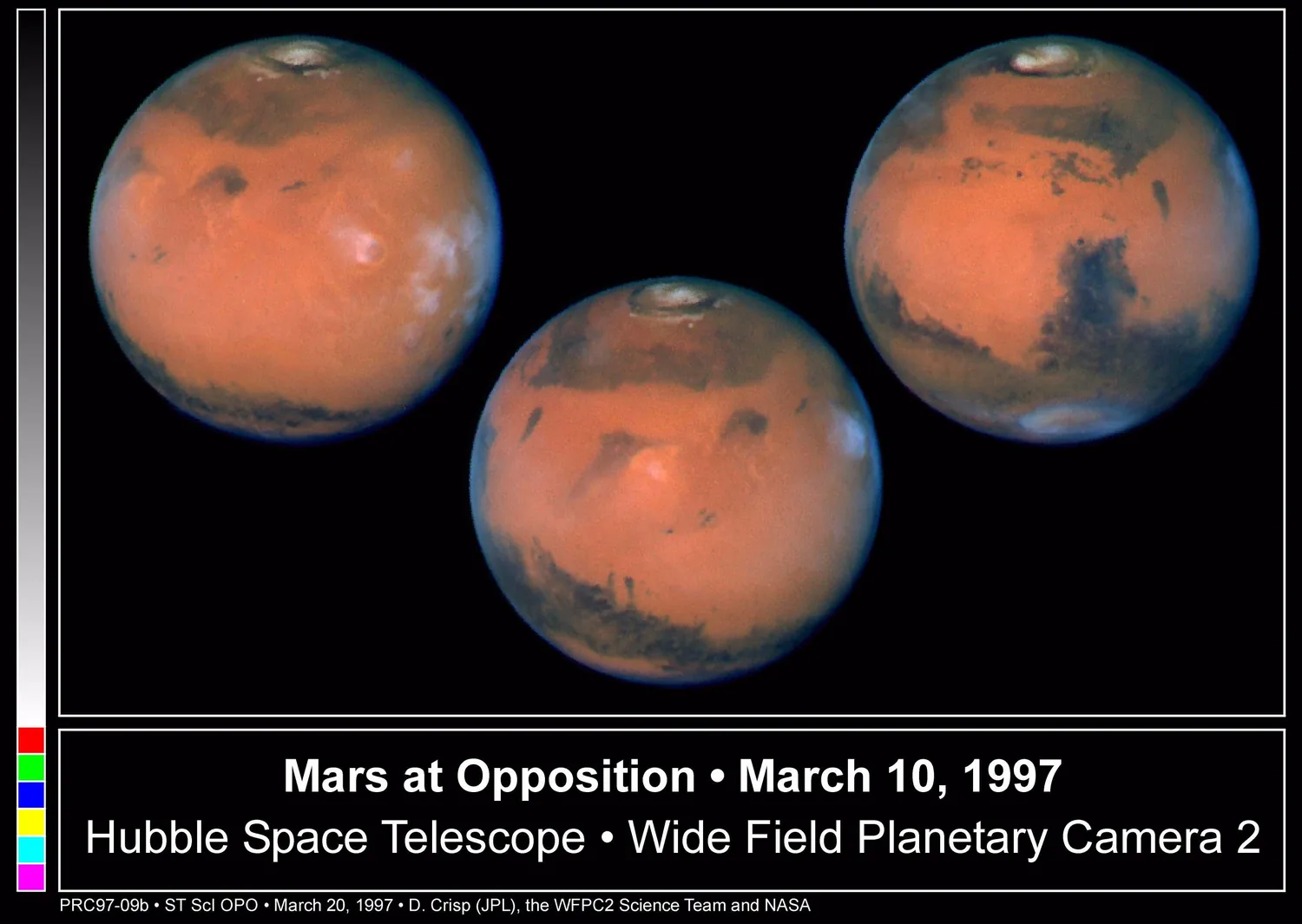
About Mars
Mars is the fourth planet from the Sun, a cold, thin-atmosphered desert world about half Earth’s diameter. Its dusty surface is stained red by iron(III) oxide — hematite — from eons of oxidation.
Despite its hostility, Mars is the most-explored world beyond Earth. It has been visited by dozens of successful orbiters, landers, and rovers since Mariner 4’s flyby in 1965. Olympus Mons, a shield volcano 21.9 km tall and 600 km wide, is the largest known volcano in the Solar System. The Valles Marineris canyon stretches over 4,000 km — a scar that would cross the entire continental United States.
Abundant geologic evidence — valley networks, deltas, hydrated minerals, subsurface water ice — confirms that liquid water once flowed on Mars’s surface, and recent discoveries by orbiting radar (MARSIS, SHARAD) and the Mars Reconnaissance Orbiter suggest vast reservoirs of subsurface water ice. Mars is the primary focus of NASA’s and China’s human spaceflight ambitions through the 2030s. The Perseverance rover is caching samples for an eventual Mars Sample Return campaign.
Physical Properties
Atmosphere Composition
- Carbon Dioxide (COu2082) 95.32%
- Nitrogen (Nu2082) 2.7%
- Argon 1.6%
- Oxygen 0.13%
- Carbon Monoxide, Water vapor trace
Orbit
Notable Moons
Missions to Mars
24 spacecraft tracked on Space Launch Live.
Gallery
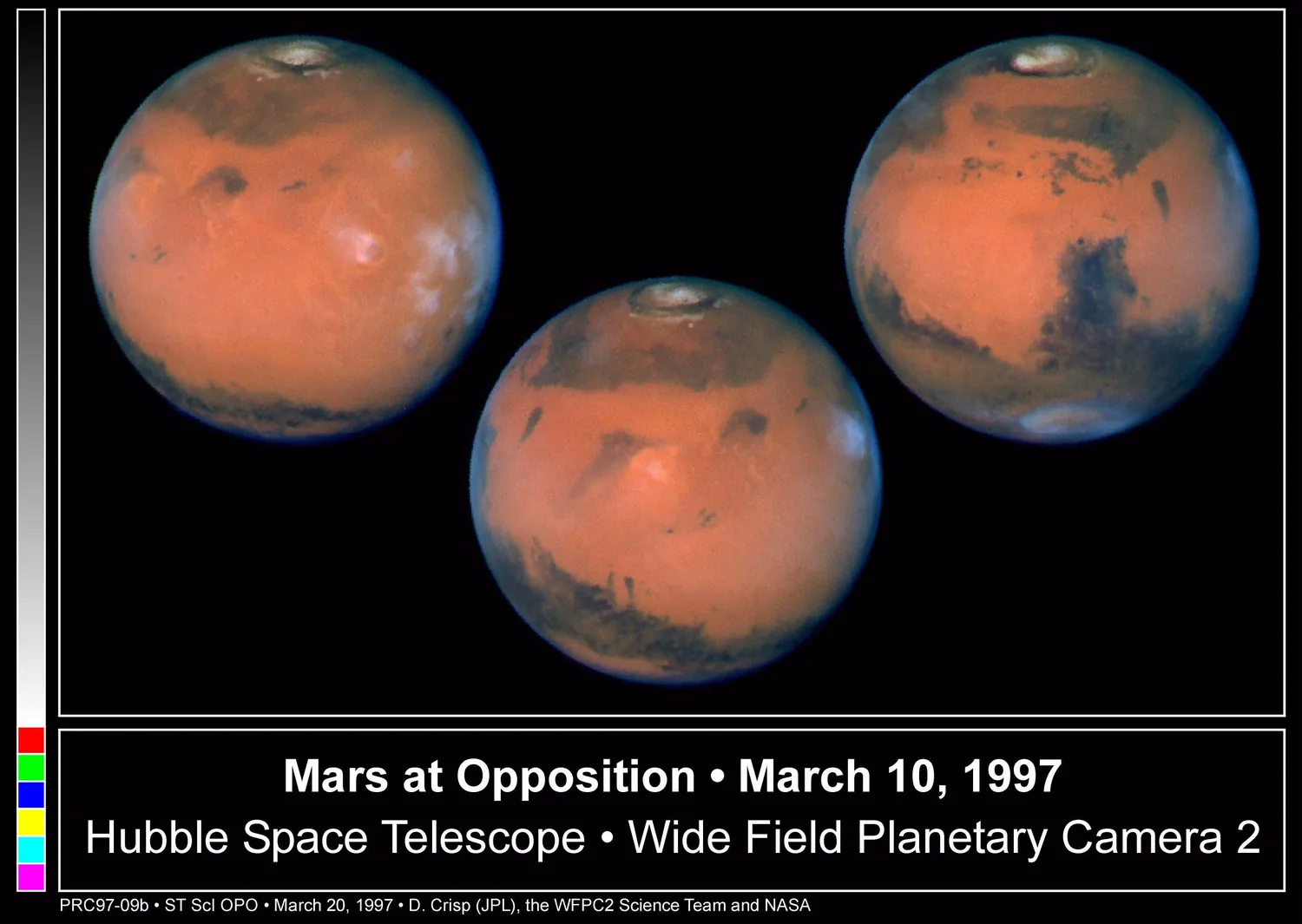
Hand-picked mission imagery of Mars sourced from NASA and partner archives. Click any photo for full resolution and source attribution.
Imagery on this page is provided by the original mission teams. Full attribution terms: Image Rights & Credits.
Sources & Further Reading
- NASA — official mission / factsheet page
- NASA JPL — orbital data and imaging
- Wikipedia — extensive cross-referenced article
- NASA Mars Fact Sheet (NSSDC)
- NASA Mars Exploration Program
- NASA u2014 Perseverance
Numerical values (radius, mass, orbital elements, temperatures) are drawn from NASA NSSDC Planetary Fact Sheets, JPL Horizons, and the JPL Small-Body Database. Last refreshed: 2026-06-08 01:37:01.